| Language Endangerment Status | |
|---|---|
| Extinct (EX) | |
|
|
| Endangered | |
|
|
| Safe | |
| |
Other categories | |
Related topics | |
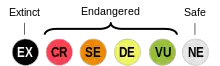 UNESCO Atlas of the World's Languages in Danger categories | |
This article is a list of languages and dialects that have no native speakers, no spoken descendents, and diverged from their parent language in Europe.
List
See also
References
- ↑ "Aequian - MultiTree". LINGUIST List. Archived from the original on 30 August 2021. Retrieved 4 September 2023.
5th to 3rd centuries BC.
- ↑ "Nordisk samekonvensjon" [Nordic Sami Convention] (PDF) (in Norwegian). 26 October 2005. Archived from the original (PDF) on 11 April 2007. Retrieved 4 September 2023.
- ↑ Versteegh, Kees (2006). Eid, Mushira (ed.). Encyclopedia of Arabic Language and Linguistics. Brill.
- ↑ Mozarabic language at the Encyclopædia Britannica
- ↑ Broderick, George (2018). "The Arran Place-Name Survey: 1974–1975". The Journal of Scottish Name Studies. University of Mannheim. 12: 4. Retrieved 5 December 2023.
The reputedly last native speaker of Arran Gaelic, Donald Craig (1899–1977)...
- ↑ Satter, Raphael (4 October 2012). "Scottish man dies, taking town's unique dialect with him". Toronto Star. Retrieved 4 September 2023.
The last native speaker of Alderney French, a Norman dialect spoken in the Channel Islands, died around 1960.
- ↑ Charles-Edwards, Thomas (29 November 2012). Wales and the Britons, 350-1064. Oxford University Press. p. 75. ISBN 978-0198217312.
- ↑ Lockwood, William (1972). A Panorama of Indo-European Languages. Hutchinson. ISBN 0091110211.
- ↑ Krause, Todd; Slocum, Jonathan. "The Corpus of Crimean Gothic". University of Texas at Austin. Archived from the original on 2 March 2007. Retrieved 4 September 2023.
- ↑ Nicolaisen, W. F. H. (1976). Scottish Place-names: Their Study and Significance. Batsford. p. 131. ISBN 0713432535.
- ↑ Haarmann, Harald (2002). "Kurisch" [Curonian]. In Okuka, Miloš (ed.). Lexikon der Sprachen des europäischen Ostens. Wieser Enzyklopaedie des europäischen Ostens (in German). Vol. 10. Klagenfurt, Austria: Wieser. p. 957. ISBN 3851295102. OCLC 610229982. Archived from the original on 19 October 2013. Retrieved 4 September 2023.
- ↑ Roegiest, Eugeen (2006). Vers les sources des langues romanes: un itinéraire linguistique à travers la Romania (in French). Acco. p. 138. ISBN 9033460947.
- ↑ "Gaelic in the North East | The School of Language, Literature, Music and Visual Culture | The University of Aberdeen". www.abdn.ac.uk.
- ↑ "Eteocypriot - MultiTree". LINGUIST List. Archived from the original on 9 June 2020. Retrieved 4 September 2023.
An ancient language of Cyprus, up to 4th C BC.
- ↑ Rix, Helmut (2004). "Etruscan". In Woodard, Roger D. (ed.). The Cambridge Encyclopedia of the World's Ancient Languages. Cambridge: Cambridge University Press. pp. 943–966. ISBN 978-0-521-56256-0.
- ↑ Stifter, David (2012), Old Celtic Languages (lecture notes), University of Kopenhagen
- ↑ Todd B. Krause and Jonathan Slocum. "The Corpus of Crimean Gothic". University of Texas at Austin. Archived from the original on 2 March 2007. Retrieved 6 February 2008.
- ↑ Magocsi, Paul R. (2015). With their backs to the mountains: a history of Carpathian Rus' and Carpatho-Rusyns. Budapest: Central European University Press. ISBN 978-963-386-107-3. OCLC 929239528.
- ↑ Fol, Alexander (2002). Thrace and the Aegean: Proceedings of the Eighth International Congress of Thracology, Sofia - Yambol, 25–29 September, 2000. Vol. 1. International Foundation Europa Antiqua. p. 225. ISBN 9549071456.
- ↑ Nahon, Peter (2023). Les parlers français des israélites du Midi (in French). ELiPhi. pp. 177–179. ISBN 978-2372760669.
- ↑ Smith, Norval (1994). "An annotated list of creoles, pidgins, and mixed languages". In Arends, Jacque; Muysken, Pieter; Smith, Norval (eds.). Pidgins and Creoles: An Introduction. John Benjamins.
- ↑ "Lemnian - MultiTree". LINGUIST List. Archived from the original on 26 September 2019. Retrieved 4 September 2023.
An ancient language of the Greek island of Lemnos. Until perhaps 400 BC.
- ↑ "Lepontic - MultiTree". LINGUIST List. Archived from the original on 7 February 2022. Retrieved 4 September 2023.
c. 600 BC - 1 BC.
- ↑ "Ligurian - MultiTree". LINGUIST List. Archived from the original on 28 September 2019. Retrieved 4 September 2023.
300 BC- 100 AD.
- ↑ "Lusitanian - MultiTree". LINGUIST List. Archived from the original on 12 April 2021. Retrieved 4 September 2023.
2nd Century AD.
- ↑ "Marsian - MultiTree". LINGUIST List. Archived from the original on 5 November 2017. Retrieved 4 September 2023.
300-150 BC.
- ↑ Joseph, Brian; Klein, Jared; Wenthe, Mark; Fritz, Matthias (11 June 2018). Handbook of Comparative and Historical Indo-European Linguistics. Vol. 3. De Gruyter. pp. 1839–1840. ISBN 978-3110542431.
- ↑ "Minoan - MultiTree". LINGUIST List. Archived from the original on 9 October 2019. Retrieved 4 September 2023.
Circa 1800 and 1450 BC.
- ↑ Post, Rudolf (2004). "Zur Geschichte und Erforschung des Moselromanischen". Rheinische Vierteljahrsblätter. 68: 1–35. ISSN 0035-4473.
- ↑ Blokland, Rogier (2003). The Endangered Uralic Languages. Amsterdam: John Benjamins Publishing Company. p. 108. ISBN 9027247528.
- ↑ North-western European language evolution: NOWELE, vols. 50–51 (Odense University Press, 2007), p. 240
- ↑ The Cambridge Encyclopedia of Language (David Crystal, editor); Cambridge University Press, 1987; p. 303: "The Isle of Man was wholly Manx-speaking until the 18th century... the last mother-tongue speakers died in the late 1940s"
- ↑ Young, Steven (2008). "Baltic". In Kapović, Mate (ed.). The Indo-European Languages. London: Routledge. pp. 486–518. ISBN 978-03-6786-902-1.
- ↑ Schrijver, Peter (2016). "Oscan love of Rome". Glotta. 92 (1): 223–226. doi:10.13109/glot.2016.92.1.223. ISSN 0017-1298. Page 2 in the online version.
- ↑ Wormald, Jenny (25 August 2005). Scotland: A History. Oxford University Press. pp. 28–32. ISBN 0198206151.
- ↑ Kapović, Mate (2008), Uvod u indoeuropsku lingvistiku [An introduction to Indo-European linguistics] (in Croatian), Zagreb: Matica hrvatska, p. 109, ISBN 978-953-150-847-6
- ↑ Bakker, P. & Nielsen, F.S., 2011. Goddeis genter! Mål & mæle, 34(1), pp.13–18.
- ↑ "Russenorsk – A Language Sketch" (PDF). Archived from the original (PDF) on 8 January 2017. Retrieved 2 November 2011.
- ↑ "Zemgalian : Encyclopedia of the Languages of Europe : Blackwell Reference Online". www.blackwellreference.com. Retrieved 28 June 2017.
- ↑ Joseph, Brian; Klein, Jared; Wenthe, Mark; Fritz, Matthias (11 June 2018). Handbook of Comparative and Historical Indo-European Linguistics. Vol. 3. De Gruyter. p. 1854. ISBN 978-3110542431.
- ↑ Gilbers, Dicky; Schaeken, Joe; Nerbonne, John (2000). Languages in Contact. Rodopi. p. 329. ISBN 9042013222.
- ↑ "South Picene - MultiTree". LINGUIST List. Archived from the original on 30 January 2020. Retrieved 4 September 2023.
6th century BC to 4th century BC.
- ↑ "Thracian - MultiTree". LINGUIST List. Archived from the original on 16 April 2022. Retrieved 4 September 2023.
1st Millennium BC - 500 AD.
- ↑ Koerner, E. F. K. (1 January 1998). First Person Singular III: Autobiographies by North American Scholars in the Language Sciences. John Benjamins Publishing. p. 33. ISBN 978-90-272-4576-2.
- ↑ Hennings, Thordis (2012). Einführung in das Mittelhochdeutsche [Introduction to Middle High German] (in German) (3 ed.). Berlin: De Gruyter. p. 26. ISBN 978-3-11-025959-9.
- ↑ Wallace, Rex (2004). "Venetic". In Woodard, Roger D. (ed.). The Cambridge Encyclopedia of the World's Ancient Languages. University of Cambridge. pp. 840–856. ISBN 0-521-56256-2.
- ↑ "Vestinian - MultiTree". LINGUIST List. Archived from the original on 31 August 2021. Retrieved 4 September 2023.
250-100 BC.
- ↑ "Volscian - MultiTree". LINGUIST List. Archived from the original on 1 September 2021. Retrieved 4 September 2023.
3rd century BC.
- ↑ Hickey, Raymond (2023). "3.6.2 The Dialect of Forth and Bargy". The Oxford Handbook of Irish English. Oxford University Press. p. 48.
After a period of decline, it was replaced entirely in the early nineteenth century by general Irish English of the region.
- ↑ Kiwitt, Marc; Zwink, Julia. "Judeo-French". Jewish Languages. Hebrew Union College – Jewish Institute of Religion. Archived from the original on 13 October 2022. Retrieved 13 October 2022.
This article is issued from Wikipedia. The text is licensed under Creative Commons - Attribution - Sharealike. Additional terms may apply for the media files.