3

I am working problem 1.1.4 from Geometry Revisited:

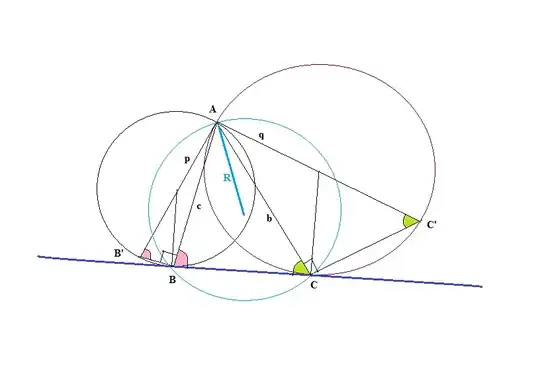
Let $p$ and $q$ be the radii of two circles through $A$, touching $BC$ at $B$ and $C$, respectively. Then $pq=R^2$.

I have read the solution Problem on Law of Sines from 'Geometry Revisited' but I'm still missing something very basic.

I can come up with infinitely many circles that go though points $A$ and $B$, and don't touch the line segment from $B$ to $C$ anywhere else (except at point $B$). Thus the statement ($pq=R^2$) can easily be made false. It is easy to find such circles for arbitrarily large radii.

In the solution posted in the link above, the circle through points $A$ and $B$ is additionally centered above point $B$ (so $B$ is the bottom point) and that fact is used in the proof. But where in the problem does it specify that condition?

Blue
  • 75,673
AlexS
  • 53
  • I have just made a comment on the linked post querying the assumption made in the original question. – Mick Nov 04 '14 at 05:18
  • Thanks @Mick. After some reflection I see that perhaps when they say "touching BC at B", "BC" is meant as the line through BC and they mean "touching the line BC only at B". It's a bit confusing though. In other parts of the book they use the notation "AB" to mean a line segment connecting A and B. – AlexS Nov 04 '14 at 05:30
  • I think both “line segment BC” and “two circles … touching BC at B and C” mean the same thing. The part that I feel not comfortable is “two circles through A”. Does it mean “two circles (passing) though A” or “two circles (touch each other at) A”? It seems to me that the drawing/solution to linked question is based on two circles intersecting each other at ONE point only. (At least it looks like that.) – Mick Nov 04 '14 at 05:53
  • @Mick that's a really interesting observation and I'm pretty sure that it's not true in general.

    To sum up:

    1. Let's agree that initial problem is ambiguous.
    2. Specifically, if we interpret $BC$ in the original problem to be "the line segment connecting $B$ and $C$", then the statement is false for reasons I gave above.
    – AlexS Nov 04 '14 at 08:20
  • If we reword the problem to "Let $p$ and $q$ be the radii of two circles through $A$, touching the line through $B$ and $C$ exactly once at $B$ and $C$, respectively. Then $pq=R^2$", then the claim is true and the proof from the link above is correct and valid. Note that it's important that the circles intersect the line (not line segment) through $B$ and $C$ exactly once.
  • – AlexS Nov 04 '14 at 08:20
  • Under the rewording of 3, there is a question about whether the two circles intersect only at A. From the diagram in the proof linked above they do. However, I don't think they do in general. I worked out the two circles for the equilateral triangle with unit sides, and the two circles did indeed intersect in 2 places (unless I made a mistake but I was very careful).
  • – AlexS Nov 04 '14 at 08:20