1

If I know the measurements of a frustum A, how can I find the measurements of frustum B if I only know B's bottom radius, slanted side angle and volume?

This problem arose after finding how deep the booze in my cocktail glass is, but when not filling the glass to the brim.

If it makes a difference, I am mostly interested in the height of each layered nested frustum inside the container frustum.

heightA       =  80.00 mm
radiusBottomA =  40.00 mm
radiusTopA    =  57.00 mm
volumeA       = 597.24 mm³
slantA        =  81.79 mm
bottomAngleA  =  12.00 °  

heightB       =  ??
radiusBottomB =  40.00 mm
radiusTopB    =  ??
volumeB       = 500.00 mm³
slantB        =  ??
bottomAngleB  =  12.00 °
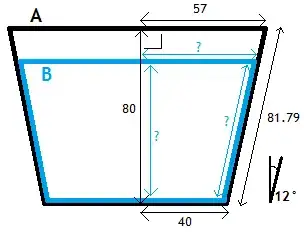
Nested frustum

The graphic is supposed to depict a 2D side-view of a frustum containing another frustum. They are supposed to be symmetrical and the proportions are not matching the indicated measurements because I have poor MS Paint skills.

2 Answers2

1

So when you are finding the area of a frustum, you are basically finding the volume of one cone and subtracting it from the volume of another cone. So, when doing this problem, just find the area of the cone formed at a given height h and subtract it from the cone at the bottom with a radius of 40.

  • I learn best by example, so could you expand your answer to include any of the given information and how they are processed to give the requested output (or at least heightB)? – Marc Dingena Nov 04 '14 at 13:42
1

I agree the easiest way is to consider the cones involved.

You can find the volume of the imaginary lower cone that is formed under the glass up to the base of the glass.
First you can use trig to find the height of that lower cone:

$$h=\frac{r}{\tan \left(θ\right)}$$ $$h=\frac{40}{\tan \left(12\right)}$$ $$h=188.1852$$

Next you can find the volume of the lower cone with:

$$V=\pi \:r^2\frac{h}{3}$$ $$V=\pi 40^2\frac{188.1852}{3}$$ $$V=315307.32897$$

So now to find the height you are after you can find the height of the overall cone with the two combined volumes (315307 + 500000), then subtract the height of the lower cone.
(Note Im assuming you meant $500ml$ not $500mm^3$. $500mm^3$ is only $0.5ml$)

We can use a formula for the height of a cone as expressed in terms of it's angle and volume:

$$h=\sqrt[3]{\frac{3V}{\pi\tan^2\left(θ\right)}}$$ $$h=\sqrt[3]{\frac{2445921}{\pi \tan ^2\left(12\right)}}$$ $$h=258.29411$$

so your answer is the height of the overall cone minus the height of the lower cone:

$$258.29411mm - 188.1852mm$$ $$70.10891mm$$

  • Theres probably a crazy way to do it all in one equation. something like

    $$h=\sqrt[3]{\frac{\pi r^3+3k\tan \left(θ\right)}{\pi \tan ^3\left(θ\right)}}-\frac{r}{\tan \left(θ\right)}$$

    – Jonathan Williams Feb 03 '20 at 14:17
  • $$\sqrt[3]{\frac{\pi :r^3+3K\tan \left(\theta \right)}{\pi \tan ^3\left(\theta \right)}}-\frac{r}{\tan \left(\theta \right)}$$

    where $r$ is the radius of the bottom of the glass, $\theta$ is the angle of the glass and $K$ is the volume of the liquid.

    $$\sqrt[3]{\frac{\pi :40^3+3\cdot 500000\cdot \tan \left(12^{\circ }\right)}{\pi \tan ^3\left(12^{\circ }\right)}}-\frac{40}{\tan \left(12^{\circ }\right)}$$

    – Jonathan Williams Feb 03 '20 at 14:25