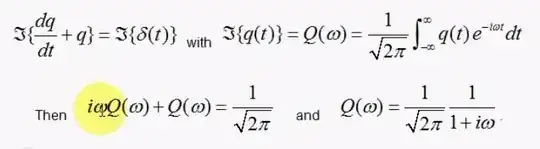
How can we deduct $iwQ(w)+Q(w)=\frac{1}{\sqrt{2\pi}}$ ?
From the first equation you have
$$\mathcal{F}\{q(t)\}+\mathcal{F}\left\{\frac{dq(t)}{dt}\right\}=\mathcal{F}\{\delta(t)\}\tag{1}$$
With $\mathcal{F}\{q(t)\}=Q(\omega)$ and with the differentiation property of the Fourier transform you get
$$\mathcal{F}\left\{{\frac{dq(t)}{dt}}\right\}=i\omega Q(\omega)$$
Finally, with $\mathcal{F}\{\delta(t)\}=1/\sqrt{2\pi}$ (1) can be rewritten as
$$Q(\omega)+i\omega Q(\omega)=\frac{1}{\sqrt{2\pi}}$$

