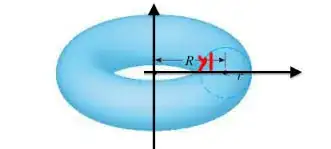
I'm way late to the party as usual, but I've got an equation for you, and some nice visuals of this object. Christian already gave the specifics a few ways. As you know, a torus can be constructed by starting with a circle in the xy plane:
$$x^2 + y^2 = r^2$$
Translate the circle by R units along the x-axis, which should be around $R = 2\cdot r$, for a ring torus,
$$(x-R)^2 + y^2 = r^2$$
Then, sweep the circle around a circular path into 3D, by replacing $x$ with $\sqrt{x^2+z^2}$ ,
$$\left(\sqrt{x^2+z^2}-R\right)^2 + y^2 = r^2$$
which gives us the equation of a torus.
To construct the $S^2$ x $S^1$ , we start with a sphere in plane $xyz$:
$$x^2 + y^2 + z^2 = r^2$$
Shift along $x$ by $R$ units where $R = 2\cdot r$,
$$(x-R)^2 + y^2 + z^2 = r^2$$
Sweep around in a circle, into 4D:
$$\left(\sqrt{x^2+w^2}-R\right)^2 + y^2 + z^2 = r^2$$
Cross Sections of $S^2$ x $S^1$
Taking some sections of this object, we can set either $w=0$ , or $z=0$:
$$\left(\sqrt{x^2}-R\right)^2 + y^2 + z^2 = r^2$$
This cross-section will give us the disjoint pair of spheres that you're looking for, centered at $(+R,0,0)$ and $(-R,0,0)$, since $\left(\sqrt{x^2}-R\right)^2$ has two values of $(x-R)^2$ and $(x+R)^2$
$$\left(\sqrt{x^2+w^2}-R\right)^2 + y^2 = r^2$$
This cross-section will give us a single torus.
Now, what does this thing look like, as sliced in 3D? Using the rotate equation,
$$\left(\sqrt{x^2+\left(w\cdot \cos(t)+z\cdot \sin(t)\right)^2}-R\right)^2 + y^2 + \left(w\cdot \sin(t)-z\cdot \cos(t)\right)^2 = r^2$$
Animating the value of t from 0 to 2$\pi$:
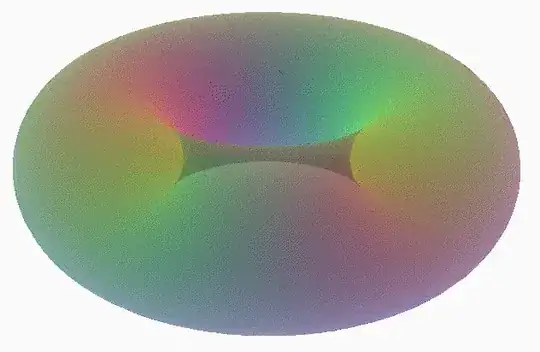
Holding at different angles, and passing through a 3-plane: