3

enter image description here

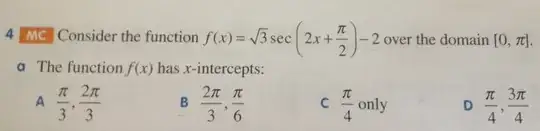
I have tried setting $f(x) = 0$ and solving for $x$ by undoing the operations, and what I end up with is $x= -\pi/6$. The book gives the answer as B, however, and I haven't been able to obtain those values using symmetry. The closest I have been able to obtain was $\pi/6$ and $5\pi/6$, and I am at a loss.

Przemysław Scherwentke
  • 13,668
  • 5
  • 35
  • 56
Jack
  • 250

2 Answers2

4

Hint

$$f(x)=\sqrt 3 \sec(2x+\frac{\pi}{2})-2=\frac{\sqrt 3}{\cos(2x+\frac{\pi}{2})}-2=\frac{-\sqrt 3}{\sin(2x)}-2$$ So, if $f(x)=0$, $$\sin(2x)=-\frac{\sqrt 3}{2}$$

I am sure that you can take from here but, just as Przemysław Scherwentke answered, I am not sure at all that the choices given in the book are correct.

2

There is a sketch of solution, for reasons at the end.

You are rather on the right path (solving $\cos(2x+\frac\pi2)=\frac{\sqrt3}{2}$, as I can assume). This gives $2x+\frac\pi2=\pm\frac\pi6+2k\pi$, i.e. $x=-\frac\pi6+k\pi$ or $x=-\frac\pi3+k\pi$. It gives $\frac23\pi$ and $\frac56\pi$, hence all answers to this question in your book are incorrect.

Przemysław Scherwentke
  • 13,668
  • 5
  • 35
  • 56