I don't understand the second line of the following expression. Why does he use conditional expectation? and can you explain the following calculation process to me? Thanks.
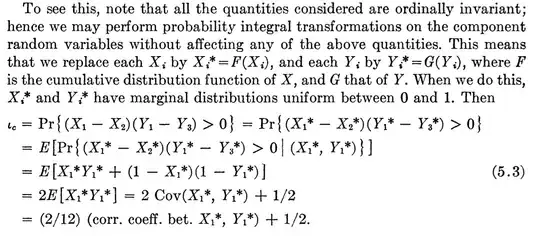
I don't understand the second line of the following expression. Why does he use conditional expectation? and can you explain the following calculation process to me? Thanks.

Do you agree with the following(?): \begin{align} \text{Pr}\left( (X_{1}^{\star} - X_{2}^{\star}) (Y_{1}^{\star} - Y_{3}^{\star})>0 \right) &= \sum_{X_{1}^{\star}, Y_{1}^{\star}} \text{Pr}\left( (X_{1}^{\star} - X_{2}^{\star}) (Y_{1}^{\star} - Y_{3}^{\star})>0\; \vert\; X_{1}^{\star}, Y_{1}^{\star} \right) \cdot \text{Pr}\left( X_{1}^{\star}, Y_{1}^{\star} \right)\\ &= \text{E}_{X_{1}^{\star}, Y_{1}^{\star}} \left[\text{Pr}\left( (X_{1}^{\star} - X_{2}^{\star}) (Y_{1}^{\star} - Y_{3}^{\star})>0\; \vert\; X_{1}^{\star}, Y_{1}^{\star} \right)\right] \end{align} To verify that, you may want to check the "Law of total probability".
For the next step, you have to think the following: When does it hold that $(X_{1}^{\star} - X_{2}^{\star}) (Y_{1}^{\star} - Y_{3}^{\star})>0$? There are two cases:
Recall that $X_{1}^{\star}$ and $Y_{1}^{\star}$ are now constants (given). We also know that $X_{i}^{\star}$ and $Y_{i}^{\star}$ have marginals that are uniform between $0$ and $1$. Now, I suspect that $X_{i}^{\star}$ and $X_{j}^{\star}, Y_{k}^{\star}$ for $i \neq k, i\neq j$ are independent (because they have a different subscript - am I wrong?) If I am correct, then taking into account the fact that $X_{i}^{\star}$ is uniformly distributed on $(0,1)$, we have $$ \text{Pr}(X_{2}^{\star} > X_{1}^{\star}) = (1 - X_{1}^{\star}), \quad \text{and} \quad \text{Pr}(X_{2}^{\star} \le X_{1}^{\star}) = X_{1}^{\star}. $$ Similarly, for $Y_{3}^{\star}$.
Then, the third step follows from the linearity of expectation and the next by the definition of covariance. Note that the expected value of both $X_{i}^{\star}$ and $Y_{i}^{\star}$ is equal to $1/2$.
