I was thinking as to why $\theta$ has been taken from $0$ to $2\pi$ . It is not obvious from the picture . Also can it be done using stokes.Thanks
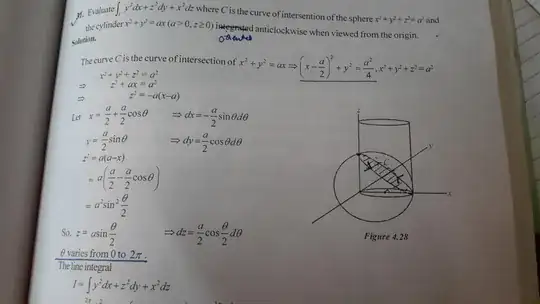
I was thinking as to why $\theta$ has been taken from $0$ to $2\pi$ . It is not obvious from the picture . Also can it be done using stokes.Thanks


The solution observes that the equation for the cylinder $x^2+y^2=ax$ is equivalent to $$(x-\tfrac{a}{2})^2+y^2=\tfrac{a^2}{4}$$ which should remind you of the equation of a circle (since we are working in three dimensions it is actually the equation of a cylinder; the $z$ variable is free). This is completing the square.
The standard parametrization of a circle of radius $r$ is $$\theta\mapsto (r\cos(\theta),r\sin(\theta))$$ with $\theta$ ranging from $0$ to $2\pi$. (Remember, the perimeter of a circle of radius $r$ is $2\pi r$.)
Anyway, that means for every point $(x,y,z)$ on the cylinder, there is a $\theta$ such that $$(x,y,z)=(\tfrac{a}{2}+\tfrac{a}{2}\cos(\theta),\;\tfrac{a}{2}\sin(\theta),\;z)$$ and the solution observes that the points that are on the cylinder and on the sphere (i.e. the points on the curve $C$) are precisely those for which $z=a\sin(\frac{\theta}{2})$.

The region contained in the "shadow" of the intersection, being the interior of a cylinder, is a circle centered at $(a/2,0)$ and has radius $a/2$. A circle $(x-h)^2+(y-k)^2=r^2$ is parameterized by (there is more than one way, however)
$$\begin{matrix}x=h+r\cos\theta\\ y=k+r\sin\theta\end{matrix}$$
where $0\le \theta < 2\pi$. This particular parameterization satisfies the counter-clockwise movement. If you know $z$ in terms of $(x,y)$ now you also know $z$ in terms of theta.
To use Stokes: You can quickly see that $\text{curl}F=0$, so the integral is zero.
