You are correct, the area of parallelogram spanned by vectors is the magnitude of the cross product $$A = || a|| \, ||b|| \sin \theta = |\vec{a} \times \vec{b}|$$ As a vector $ \vec{a}\times \vec{b}$ points in a direction normal to the plane of $\vec{a}$ and $\vec{b}$. Does it then make sense that $\nabla \times \vec{a}$ is the area of the "parallelogram" spanned by $\nabla = (\partial_x, \partial_y, \partial_z)$ and $\vec{a}$?
Curl can be defined as the limit of a line integral over an infinitesimally small circle:
$$ (\nabla \times \vec{F})\cdot \hat{n} = \lim_{|A| \to 0} \frac{1}{|A|} \oint_C \vec{F} \cdot d\vec{r} $$
The macroscale version of is the Kelvin-Stokes theorem that relates the curl across a circle to the total vector field around a loop:
$$ \int_S (\nabla \times \vec{F}) \cdot dS = \oint_{\partial S} \vec{F} \cdot d \vec{r}$$
Another way to think of curl is to use exterior algebra. In which case, $\nabla \times F$ is technically a 2-vector:
\begin{eqnarray} d(\ast F) &=& d(F_x dx + F_y dy + F_z dz) \\
&=& (\partial_x F_y - \partial_y F_x) dx \wedge dy
+ (\partial_y F_z - \partial_z F_z) dy \wedge dz
+ (\partial_z F_x - \partial_x F_y) dz \wedge dx\end{eqnarray}
This 2-form can represent a kind of area.
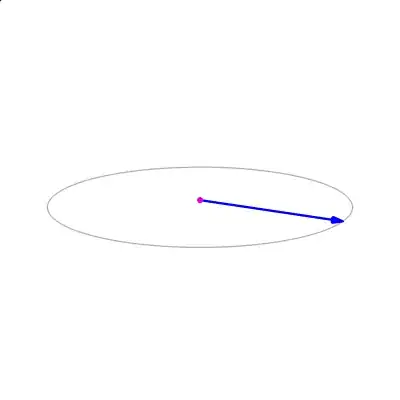
Philosophically it could be that same data that defines an area (a plane), also defines defines the axis of rotation normal to it in 3D space.
