If $\mathbb P(X=m)=(1-p)^mp$ for $m\geqslant 0$ then $$\mathbb P(X\geqslant m)=\sum_{k=m}^\infty (1-p)^kp = p(1-p)^m\sum_{k=0}^\infty (1-p)^k=(1-p)^m. $$
Moreover, we have
$$
\{X\wedge Y=m\} = \{X=m,Y\geqslant m\}\cup\{Y=m,X\geqslant m\},
$$
with each event on the right-hand side sharing the member $\{X=m,Y=m\}$. Subtracting this off, we have
\begin{align}
\mathbb P(M=m) &= \mathbb P(X\wedge Y=m)\\
&= \mathbb P(X=m)\mathbb P(Y\geqslant m) + \mathbb P(Y=m)\mathbb P(X\geqslant m) - \mathbb P(X=m)\mathbb P(Y=m)\\
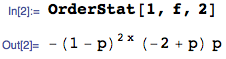
&= (1-p)^mp + (1-p)^mp - (1-p)^mp(1-p)^mp\\
&= 2(1-p)^{2m}p - (1-p)^{2m}p^2\\
&= (1-p)^{2m}p(2-p).
\end{align}
(Substituting $q=1-p$ yields $q^{2m}(1-q^2)$, as noted in @wolfies's answer.)
For $D=X-Y$, note that for $m\geqslant 0$, $$\{X-Y=m\} = \{X=Y+m\} = \bigcup_{k=0}^\infty \{X=k,Y=m+k\},$$ and so
\begin{align}
\mathbb P(D=m) &= \mathbb P(X-Y=m)\\
&= \mathbb P\left(\bigcup_{k=0}^\infty \{X=k,Y=m+k\}\right)\\
&= \sum_{k=0}^\infty (1-p)^k(1-p)^{m+k}p^2\\
&= (1-p)^mp^2\sum_{k=0}^\infty (1-p)^{2k}\\
&= \frac{(1-p)^mp^2}{1-(1-p)^2}\\
&= \frac{(1-p)^mp}{2-p}.
\end{align}
For $m<0$ we have $$\{X-Y=m\} = \{Y-X=-m\} = \{Y-X=|m|\}, $$
so by symmetry
$$
\mathbb P(D=m) = \frac{(1-p)^{|m|}p}{2-p}.
$$