Is it possible to find the coordinates of the point marked (?,?) if I have a rectangle/right triangle with a given point and the length of the hypotenuse?
See image: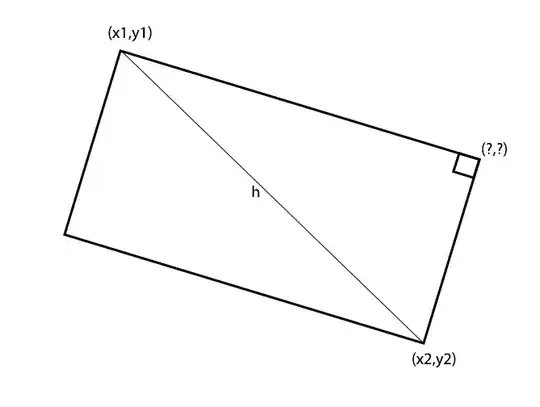
Thanks everyone.
Is it possible to find the coordinates of the point marked (?,?) if I have a rectangle/right triangle with a given point and the length of the hypotenuse?
See image:
Thanks everyone.


Let the point be $(x,y)$. The two lines perpendicular to each other must have the product of their slopes equal to $-1$. Therefore you get $$\frac{y_1-y}{x_1-x}\frac{y_2-y}{x_2-x}=-1$$ Now using distance formula, you can get your second equation $$(x_1-x)^2+(y_1-y)^2+(x_2-x)^2+(y_2-y)^2=h^2$$ When you solve for x,y , you shall get a set of points(locus) satisfying it. In this case, it's a circle. Therefore, the point can be determined but not uniquely.
The blue rectangle has all the same properties as the rectangle you are looking for: same corners $(x_1, y_1)$ and $(x_2, y_2)$ and same hypotenuse, $h$; but clearly it is not the same rectangle. So no, the given information is not enough to determine the coordinates of the point $(?,?)$, which could be either at the corner of the black rectangle, the corner of the blue rectangle, or at the corner of any of many other rectangles that could be drawn with the same diagonal.
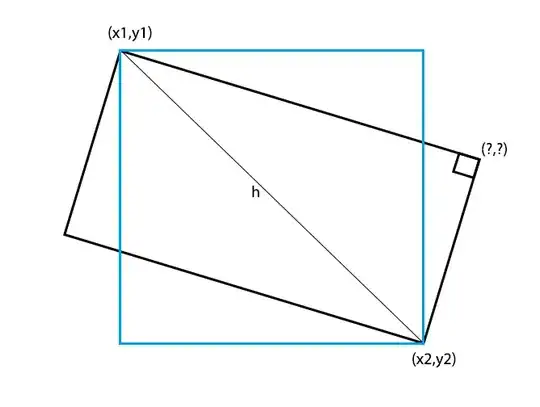

Hammer two nails into the top of your desk or table at the two given points $P_1 = (x1, y1)$ and $P_2 = (x2, y2)$. Place a large rectangular piece of cardboard so that two adjacent sides touch the two nails. The corner where these two sides meet is the point $P= (?,?)$.
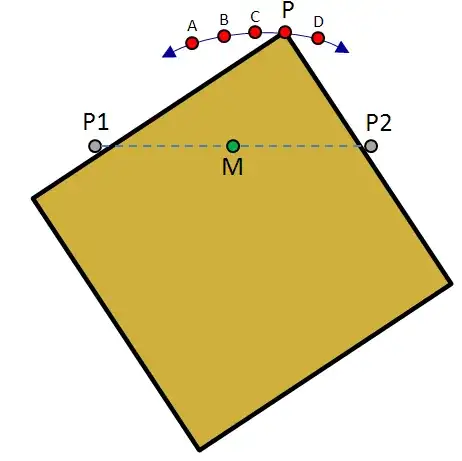
Can you slide the cardboard around (causing the point $P$ to move), or is its position fixed?
For extra credit:
Mark the midpoint $M$ between $P1$ and $P2$.
Mark several points $A$, $B$, $C$, $D$, etc. that $P$ travels to as you move the cardboard.
Measure the distance from each of $A$, $B$, $C$, $D$ to $M$.
Think about what kind of curve the point $P$ is traveling along as it moves.
