Is there some fractal like the koch snowflake, but only with many circles around a bigger initial circle, each of them surrounded by smaller circles and so on (but all of them kissing one bigger circle)? So circles instead of the triangles in a koch snowflake... If not, why?
Asked
Active
Viewed 2,094 times
6

-
4I'm not sure of all the details you want, but anything you can imagine or roughly draw could certainly be "fractalized", but there remains the question of why someone would want to study it. Possible close to what you want might be Apollonian Gasket, however. – Dave L. Renfro Feb 09 '15 at 19:35
-
1An apollonian gasket comes close to what I imagine, yes! I honestly don't know a reason to study it, aside that it maybe beautiful(probably not as beautiful as the gasket). – user2103480 Feb 09 '15 at 20:27
-
Apollonian Gasket seems like the best answer so far. – alan2here May 21 '17 at 17:42
4 Answers
9
Parts of the Mandelbrot set look like circles with smaller circles attached recursively:
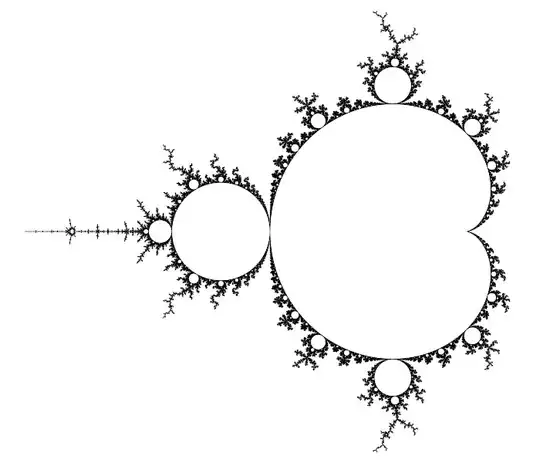
They aren't quite exact circles (except for the one centered at $-1+0i$), but the property that the radius of the smaller circle attached at rational angle $\frac{p}{q}$ measured in turns is approximately $q^2$ times smaller provides a way to construct a similar fractal from exact circles:
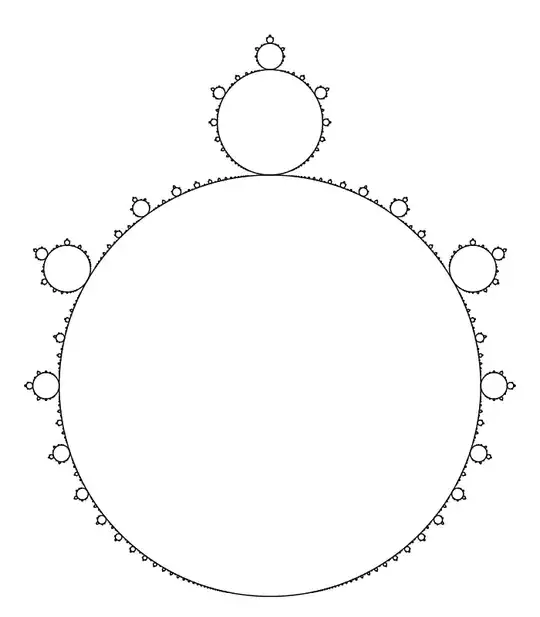
Haskell source code using the Diagrams library:
import Diagrams.Prelude
import Diagrams.Backend.SVG.CmdLine (defaultMain)

main
  = defaultMain
  $ diagram 1
  # rotateBy (-0.25)
  # pad 1.1
  # lw thin
  # bg white

power = 2

minimumRadius = 0.001

diagram radius
  | radius < minimumRadius = mempty
  | otherwise = circle radius <> mconcat
     [ diagram r
     # rotateBy (s - 0.5)
     # translate (r2 (rr * cos t, rr * sin t))
     | den <- [ 2 .. ceiling (sqrt (radius / minimumRadius)) ]
     , num <- [ 1 .. den - 1 ]
     , num `gcd` den == 1
     , let s = fi num / fi den
     , let t = 2 * pi * s
     , let r = radius / fi den ** power
     , let rr = radius + r
     ]
  where
    fi = fromInteger
Reducing the power makes the circles larger, but too low and they eventually overlap - in any case the power must be larger than one to ensure the circles actually do get smaller.


-
(+1) Thanks for the code :) Circles overlaping was a concern of mine, too - you found a real nice reduction to what I was looking for! – user2103480 Feb 09 '15 at 20:46
-
Can you link a version of the 2nd picture here where the power is set such that the circles get smaller as gradually as they can without overlapping? – alan2here May 14 '17 at 19:52
-
1@alan2here I suspect that the minimal power without overlap is in fact $2$, as in the picture, though I haven't a proof yet. Maybe the fact that $\operatorname{exsec} \theta \approx \frac{1}{2}\theta^2$ has something to do with it? – Claude May 16 '17 at 16:25
-
https://commons.wikimedia.org/wiki/File:Shrub_model_of_Mandelbrot_set_60_10_labelled.png – Adam Jan 01 '19 at 19:39
8


Mark McClure
- 30,510
-
2I think this is definitely the closest out of the three answers to matching the spirit of OP's question. It's very mesmerizing. +1 – Cameron Williams Feb 10 '15 at 06:15
-
Yes, I'll chose this as the answer! Almost exactly as I imagined it... but more beautiful! I liked the other answers too, though :) – user2103480 Feb 10 '15 at 14:10
7
Maybe the "Pharaoh's Breastplate" described by Mandelbrot.
 Here plotted by Ken Monks

GEdgar
- 111,679
2
If you draw 6 smaller circles inside each circle you draw... you end up with something like a

My rendering only draws 6 iterations deep - but you could theoretically go forever.

Xander Henderson
- 29,772

Tom H
- 21
- 1
-
2That construction is usually called the "hexagasket". It is a specific example of a general construction called an "$n$-gasket" (in case you are looking for things to Google). – Xander Henderson Jan 14 '19 at 22:01