0

Would you help me demonstrate with Lagrange's theorem that

$$\sin x < x < \tan x \quad\text{for }x\in \left(0,\frac{\pi}2\right)$$

I am not so advanced in mathematics, we haven't seen this theorem in class, so I really start from nothing.

Rory Daulton
  • 32,288
  • By "Lagrange's theorem" do you mean his version of the Mean Value Theorem? There are many ways to prove your desired statement, including geometric--you can't use another method? – Rory Daulton Mar 20 '15 at 19:25
  • This depends on your definition of $\sin x$ and $\tan x$. – Yuval Filmus Mar 20 '15 at 19:26
  • No I can't use an other method. I haven't had any more infos. And I never heard about the mean value theorem... – Cotopaxxi Mar 22 '15 at 19:36

2 Answers2

3

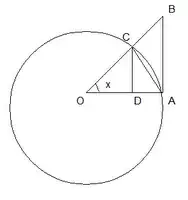
unit circle

Consider the unit circle above. It is clear that the area of triangle $OAB$ is greater than the area of sector $OAC$ which is greater than the area of triangle $OAC$.

What is the area of triangle $OAB$? $\frac{1}{2}(1)(\tan(x))$.

What is the area of sector $OAC$? $\frac{1}{2}(1^{2})(x)$

What is the area of triangle $OAC$? $\frac{1}{2}(1)(\sin(x))$

The desired inequality follows.

Tim Clark
  • 418
  • This is a nice proof but it seems the OP wanted a proof using the mean value theorem. I've upvoted it anyway because it's a nice way to geometrically see why this should be the case. – Cameron Williams Mar 20 '15 at 20:13
  • Good call. I had never heard the MVT called "Lagrange's theorem", so I figured sin(x) < x < tan(x) was Lagrange's theorem. I didn't read the question closely enough! – Tim Clark Mar 20 '15 at 20:24
  • It's definitely far from a standard use of the term. I don't blame you. Don't delete your answer though. It's one of the more elegant answers I've seen for these. – Cameron Williams Mar 20 '15 at 20:32
1

Here is a start of one proof using the Mean Value Theorem. Use the fact that for $x\in \left(0,\frac{\pi}2\right)$,

$$\frac{d}{dx}\sin x<1=\frac{d}{dx}x<\frac{d}{dx}\tan x$$

Then look at the interval between $0$ and $x$ using the Mean Value Theorem.

Rory Daulton
  • 32,288
  • not a proof.... –  Mar 22 '15 at 00:35
  • @ProbabilityGuy: What do you mean? If the inequalities in my answer are given, they can be combined with the Mean Value Theorem to give a proof. I said what I wrote was a start... not the whole proof. – Rory Daulton Mar 22 '15 at 00:40
  • I dont get what you are saying but still this is not a proof –  Mar 22 '15 at 07:40