Quadrilateral $ABCD$ is cyclic, with $BC=BD=1$. If $AD:AC:AB=1:7:5$, then find $AD^2$. I tried applying Ptolemy's theorem, I got $CD$, and then some angles but it did not give me something.
Asked
Active
Viewed 540 times
2
-
If you got CD, than the rest should be easy... I think. – Moti Mar 24 '15 at 05:37
-
How? What should I do then? – Mar 24 '15 at 05:50
-
Did you try Heron's formula for triangle area? – Moti Mar 24 '15 at 05:59
-
Did you try this? - If ABCD is a cyclic quadrilateral, then AC⋅(AB⋅BC+CD⋅DA)=BD⋅(DA⋅AB+BC⋅CD) – Moti Mar 24 '15 at 06:01
-
Thanks, but how did you get this result? Also, from this I am getting the answer 6/192, could you check, where is it wrong? – Mar 24 '15 at 06:12
-
I just found another question that suggest this property. Look to the right of the comments at the "Related" section. – Moti Mar 24 '15 at 06:16
-
@garvil where do you get all these questions about cyclic quadrilaterals? – najayaz Mar 24 '15 at 06:21
-
I am getting CD = 1.2 and from here: 0.1768 – Moti Mar 24 '15 at 06:22
-
Please, fractions. I also got the same value of $CD$. – Mar 24 '15 at 06:41
2 Answers
0
Let $AD=x=\frac{AC}{7}=\frac{AB}{5}$. Then according to Ptolemy's theorem, $1(7x)=1(x)+(CD)(5x)$, which gives $CD=\frac{6}{5}$. Now let the midpoint of $CD$ be $M$. We see that $\cos\angle CAB=\cos\angle CDB=\frac{DM}{BD}=\frac{3}{5}$, and then it follows from the law of Cosines on triangle $ABC$ that:
$$(5x)^2+(7x)^2-2(7x)(5x)(\frac{3}{5})=1^2\implies x^2=\boxed{\frac{1}{32}}$$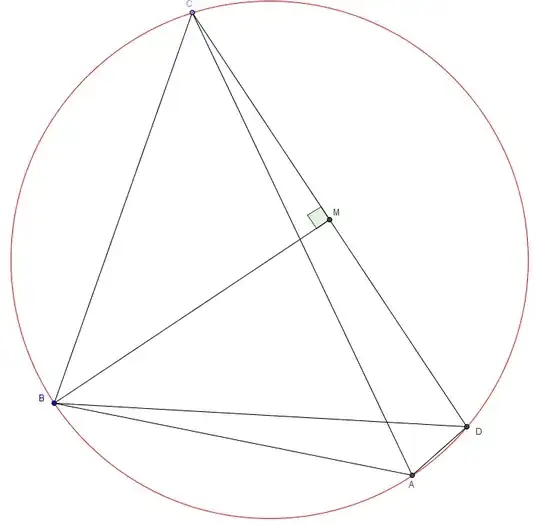

Apple
- 1,386
0
Ptolemy's theorem to get CD: $(5x)(CD) + (1)(x) = (1)(7x)$, $CD = 1.2$
Then just apply diagonal ratios formula from this link.
Let $ABCD$ be a cyclic quadrilateral with side lengths $AB=p,BC=q,CD=r,DA=s$.Show that $\dfrac{AC}{BD}=\dfrac{ps+qr}{pq+rs}$.
For this problem, $p=5x$, $q=1$, $r=1.2$, $s=x$
$$\frac{AC}{BD} = \frac{7x}{1} = \frac{5 x^2 + 1.2}{5x + 1.2x}$$
$$43.4 x^2 = 5 x^2 + 1.2 $$ $$x^2 = \frac{1.2}{43.4-5} = 0.03125 = \frac{1}{32}$$

tinlyx
- 1,534

albert chan
- 2,114