can some one tell me the differences between these two approximation techniques, what are the strengths and weaknesses of each, and which better one to use. Thanks
Asked
Active
Viewed 5,819 times

1 Answers
0
Look here for some nice answers: https://stats.stackexchange.com/questions/33659/how-is-interpolation-related-to-the-concept-of-regression.
Also, the following picture shows you a curve, which is an interpolation of the three points, and a line, which is the least square fit of the points.
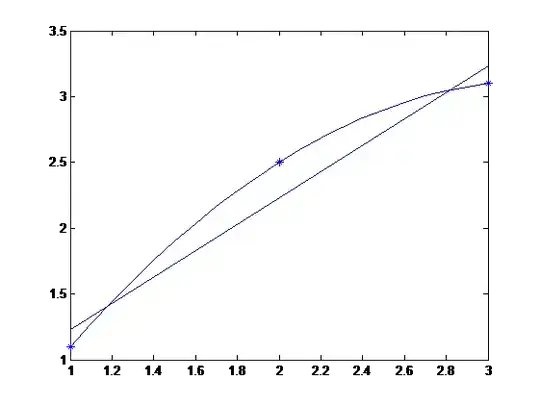
The error of the least square fit of course comes from its own formulation. The error analysis of interpolation is as follows:
Assume that $P(x)$ is the (degree $n-1$ or less) interpolation polynomial fitting the $n$ points $(x_1,y_1),..., (x_n,y_n)$ on a function $f(x)$. The interpolation error is
$$f(x)-P(x)=\frac{(x-x_1)...(x-x_n)}{n!}f^{(n)}(c)$$,
where $c$ lies between the smallest and largest of the numbers $x,x_1,..., x_n$.
There is no general rule as to which one to use. It largely depends on what kind of problem you are dealing with, how much data you have, and how much you know your model.


-
In the above link they talked about interpolation and regression as general. Ineed the differences between Lagrange interpolation and least squares that have the same polynomial degree – sahar salah eldeen Mar 26 '15 at 06:56
-
The answer still applies. In the fist answer, just look at $F(x)$ as the same degree polynomial. Basically, interpolation gives you a curve that exactly cross through the data points, least square gives you a curve that approximate the data points, such that the error is minimized. For instance, if the data points contain too much errors, least square is a better choice. – KittyL Mar 26 '15 at 09:21
-
What about errors in the two techniques – sahar salah eldeen Mar 26 '15 at 09:39
-
@saharsalaheldeen: I edited the answer. – KittyL Mar 26 '15 at 13:10