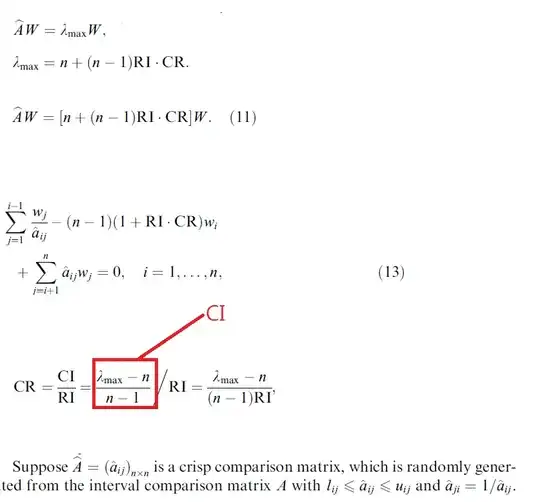
For some fixed $i$, your equation (13) is just the equality of (11), but looked at from the perspective of the $i$'th component: Equation (11) states that two vectors are equal, while equation (13) states that some number is equal to $0$, where this number depends on $i$. Let me repeat equation (11) here:
$$\widehat{A}W=\lambda_{\text{max}}W,$$
where
$$\lambda_{\text{max}} = n+(n-1)\text{RI}\cdot\text{CI}.$$
So let us look at the $i$'th component of equation (11). Oh, you didn't say so, but it looks like the diagonal of the matrix $A$ consists of all $1$'s, so that $a_{ii}=1$ for all $i=1,\cdots,n$. We are going to need this. Consider first the left hand side $\widehat{A}W$ of the equation.
Remember how you multiply a matrix by a vector? You do this "row by column". If I want to find the $i$'th component of the vector $\widehat{A}W$, then I take the $i$'th row of $\widehat{A}$ and multiply it component by component with $W$, and then add all the products. Denoting by $[\widehat{A}W]_i$ the $i$'th component of this vector, I get:
$$[\widehat{A}W]_i = \sum_{j=1}^n \hat{a}_{ij}w_j.$$
But you said so yourself that if the upper triangular entries of $\widehat{A}$ are $\hat{a}_{ij}$, then the lower triangular entries are $1/\hat{a}_{ij}$. To illustrate, this is the $4\times 4$ version of $\widehat{A}$:
$$\begin{bmatrix}
1 & \hat{a}_{12} & \hat{a}_{13} & \hat{a}_{14}\\
1/\hat{a}_{12} & 1 & \hat{a}_{23} & \hat{a}_{24}\\
1/\hat{a}_{13} & 1/\hat{a}_{23} & 1 & \hat{a}_{34}\\
1/\hat{a}_{14} & 1/\hat{a}_{24} & 1/\hat{a}_{34} & 1
\end{bmatrix}$$
So my $i$th component of $\widehat{A}W$ from above actually turns into
$$[\widehat{A}W]_i = \sum_{j=1}^{i-1}\frac{w_j}{\hat{a}_{ij}}+w_i+\sum_{j=i+1}^nw_j\hat{a}_{ij}.$$
What happened? I looked at the $i$'th row of $\widehat{A}$, and realized that I can group the elements of $\widehat{A}$ such that the first sum above comes from all the terms below the diagonal, the middle term corresponds to the diagonal element $(i,i)$, and the last sum comes from all the terms of row $i$ that are above the diagonal.
Now I want to consider the right hand side $\lambda_{\text{max}}W$ of equation (11). You know that
$$\lambda_{\text{max}} = n+(n-1)\text{RI}\cdot\text{CI},$$
and I will just rewrite this slightly as follows.
$$\lambda_{\text{max}} = n+(n-1)\text{RI}\cdot\text{CI} = 1+(n-1)+(n-1)\text{RI}\cdot\text{CI}=1+(n-1)(1+\text{RI}\cdot\text{CI}).$$
The expression $\lambda_{\text{max}}W$ is really just a number $\lambda_{\text{max}}$ times a vector $W$, and I can calculate this by multiplying each entry $w_i$ of $W$ by $\lambda$. Using my new expression for $\lambda$, I get:
$$[\lambda W]_i = (1+(n-1)(1+\text{RI}\cdot\text{CI}))w_i=w_i+(n-1)(1+\text{RI}\cdot\text{CI})w_i.$$
So I have now calculated the $i$'th component of the left hand side and of the right hand side of equation (11), and letting these two expression be equal, I obtain:
$$\sum_{j=1}^{i-1}\frac{w_j}{\hat{a}_{ij}}+w_i+\sum_{j=i+1}^nw_j\hat{a}_{ij}=w_i+(n-1)(1+\text{RI}\cdot\text{CI})w_i.$$
Notice how I can cancel the term $w_i$ from both sides. Doing this, I get:
$$\sum_{j=1}^{i-1}\frac{w_j}{\hat{a}_{ij}}+\sum_{j=i+1}^nw_j\hat{a}_{ij}=(n-1)(1+\text{RI}\cdot\text{CI})w_i.$$
This is practically equation (13)! Moving the left hand side over to the right hand side (and changing the sign), I finally obtain:
$$\sum_{j=1}^{i-1}\frac{w_j}{\hat{a}_{ij}}-(n-1)(1+\text{RI}\cdot\text{CI})w_i+\sum_{j=i+1}^nw_j\hat{a}_{ij}=0,$$
which is what I set out to show.