1

How can I split a polynomial into parts which are symmetric and antisymmetric under exchange of the variables? I have an explicit polynomial, which is a function of three variables (and some further constants). The symmetry properties should be with respect to all three variables. In the following image you can see the polynomial as well as further explanations and some ideas I already had.
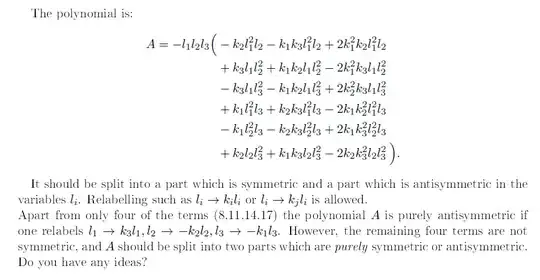
enter image description here

Thomas
  • 167
  • Your question is quite difficult to handle, you should edit it. For example, can you please give us your polynomial? – User3773 Mar 25 '15 at 18:47
  • Thank you for the comment. I edited my question and would be very grateful if you could help me. – Thomas Mar 25 '15 at 20:53

1 Answers1

1

If $f(x_1, x_2, \dots x_n)$ is a polynomial, then its symmetric part is

$$\frac{1}{n!} \sum_{\sigma \in S_n} f(x_{\sigma(1)}, x_{\sigma(2)}, \dots x_{(\sigma(n)})$$

and its antisymmetric part is

$$\frac{1}{n!} \sum_{\sigma \in S_n} \text{sgn}(\sigma) f(x_{\sigma(1)}, x_{\sigma(2)}, \dots x_{(\sigma(n)}).$$

Here $S_n$ is the group of permutations of $n$ objects and $\text{sgn}(\sigma)$ is the sign of a permutation.

However, when $n \ge 3$ it is just not true that a polynomial is the sum of its symmetric part and its antisymmetric part. In general there are other parts that behave in more complicated ways under the action of $S_n$ given by the other irreducible representations of $S_n$.

Qiaochu Yuan
  • 419,620
  • Thank you for your help! What happens if I set l_1 equal to 1? Then the polynomial should only be symmetric/antisymmetric under exchange of two variables, not three anymore. Could the polynomial then be easily split into a symmetric and an antisymmetric part? – Thomas Mar 26 '15 at 11:15
  • Thanks for answering my question. Since the problem with two variables is a different one, I just asked a new question. – Thomas Mar 26 '15 at 11:44