2

I am solving a problem and just can't wrap my had around the result I'm getting... Here it is: enter image description here
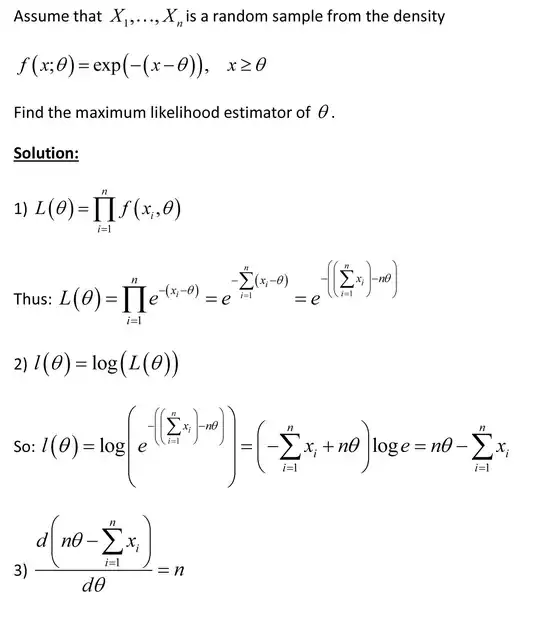
So my next step would be setting derivative equal to zero and solving for Theta... Are my calculations wrong?... I would appreciate any constructive advice.

  • I'm no expert, but this doesn't seem like a simple problem...having said that, assuming (1) is true, your steps look correct. +1 for interesting manipulations of the summation/product series. – Zach466920 Mar 25 '15 at 19:34
  • You've missed the $x\ge \theta$ constraint. Your manipulations are correct, though. You should read this so you don't have to post bulky, unsearchable images with math on it when you can use $\LaTeX$ commands directly using MathJax. – AlexR Mar 25 '15 at 19:38
  • 1
    For the love of Gauss please typeset this thing correctly... – Daniel W. Farlow Mar 25 '15 at 21:49
  • Gauss is off building an arc... – copper.hat Mar 26 '15 at 00:31

2 Answers2

1

You are getting stuck because you are treating $L$ as if it was differentiable everywhere. Note that if $\theta > x_k$ for any $k$, then $L(\theta) = 0$. If $\theta \le \min_k x_k$, then $L$ is an increasing function of $\theta$. Hence it is maximised when $\theta = \min_k x_k$.

copper.hat
  • 172,524
  • Thanks a lot! I needed to look at the definition first. This is a good reminder for me! Just one question though... Why if $\theta > x_k$ for any $k$, then $L(\theta) = 0$.? – user175755 Mar 25 '15 at 20:14
  • The density is given above by $f(x,\theta)$, and if you integrate from $\theta$ to $\infty$ you get one, so it must be zero everywhere else. – copper.hat Mar 25 '15 at 21:31
  • Oh ok, that makes sense. Thanks much! – user175755 Mar 25 '15 at 23:24
0

So, thanks to the great advices from @copper.hat and @AlexR I made an attempt to explain the solution using the definition of MLF: The function in 1) is an increasing function of the argument Theta, thus it reaches its maximum value at maximum value of its argument. Since we have the restriction on Theta, namely:Theta is less or equal to x, the maximum possible value of Theta will be: minimal of (X1,...,Xn), Thus the MLE of Theta is min(X1,...,Xn)

Need critique on that.