3

I have a question about the following excerpt from the paper("An Iterative Minimization Formulation for Saddle-Point Search") by Gao,Leng, Zhou on gentlest ascent in dynamical systems.enter image description here
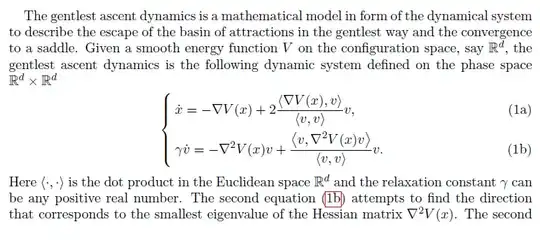
enter image description here

I am having a hard time understanding the part where it says that "the equation (1b) attempts to find the direction that corresponds to the smallest eigenvalue of the Hessian $\nabla ^2 V(x)$"

If I drop the normalization term in (1b) and set the relaxation constant $\gamma = 1$, then I am basically looking at

$$\dot v = - \nabla ^2 V(x)v \tag A$$, but why is it that this dynamic attempts to find the direction corresponding to the smallest eigenvalue of the Hessian of V?

user74261
  • 2,286

1 Answers1

1

For a fixed $x$ denote $A:=\nabla^2 V(x)$. It is a matrix. Then locally your equation looks like $\dot{v} = -A v$. By standard analysis of linear ODE if $-A$ has all e.v. not laying on the imaginary axis, then the dynamics will follow the largest e.v. of $-A$ i.e. minus the smallest e.v. of $A$.

demitau
  • 797
  • I agree that the dynamic is locally $v\dot = -Av$. But, wouldn't the dynamics will follow the largest eigenvalue of $-A$ only when t is sufficiently large? In this case, the matrix "$A$" changes with x, so the dynamics wouldn't have enough time to actually follow the largest e.v as the matrix would change – user74261 May 09 '15 at 16:47
  • This is true but still I think that authors wanted to say it. Maybe if you know that $A$ does not change very fast then it makes sense. – demitau May 10 '15 at 21:01
  • What do you mean "this"? – user74261 May 10 '15 at 22:46
  • I mean I agree that formally this alignment should happen only for large times. But from the information you provided I do not see any other possible explanation of the phrase about alignment you have cited. – demitau May 11 '15 at 07:37
