5

I was trying to find a non-trivial example of a unit speed plane curve. The reason is I want something to work with but if I start with a non-unit speed curve and then do the arc length parameterisation I end up with something impossible.

The trivial example is of course the unit circle $(\cos t, \sin t)$ but this is indeed trivial as the curvature is $1$ and also, the circle is too obvious (can determine the curvature just by looking at it).

Does anyone know a unit speed curve that is not the circle?

student
  • 1,617

1 Answers1

6

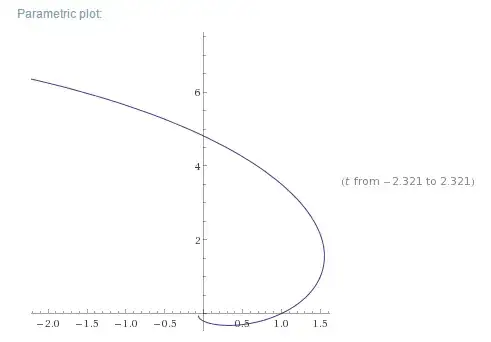
Consider the spiral $\gamma: \Bbb R \to \Bbb R^2$ given by $$\gamma(t) = (e^t\cos t, e^t \sin t).$$ Then $$\gamma'(t) = (e^t(\cos t - \sin t),e^t (\cos t+\sin t)),$$ and so: $$\|\gamma'(t)\| = e^t\sqrt{(\cos t -\sin t)^2+(\cos t+\sin t)^2} = e^t\sqrt{2}.$$ With this: $$s(t) = \int_0^t e^\xi \sqrt{2}\,{\rm d}\xi = \sqrt{2}(e^t-1) \implies t = \ln\left(\frac{s}{\sqrt{2}}+1\right).$$ So we get a nice and non-trivial unit speed curve: $$\gamma(t(s)) \equiv \gamma(s) = \left(\left(\frac{s}{\sqrt{2}}+1\right)\cos\left(\ln\left(\frac{s}{\sqrt{2}}+1\right)\right),\left(\frac{s}{\sqrt{2}}+1\right)\sin\left(\ln\left(\frac{s}{\sqrt{2}}+1\right)\right)\right).$$

enter image description here

Ivo Terek
  • 77,665
  • To compensate the earlier distraction, there goes a planar curve :D – Ivo Terek May 09 '15 at 03:47
  • Thank you very much. Do you think this is as easy as it gets? – student May 09 '15 at 11:35
  • There's a lot of interesting curves, such as the tractrix, the cycloid, the brachistochrone, tautochrone, etc, and you can parametrize these curves appealing to geometric intuition, but the issue is that the parametrization you get usually won't be by arc-length. There are formulas for expressing the curvature even when the parametrization hasn't unit speed (I refer you to John Oprea's book for that formulas, it's all well explained there). And another problem is: even using said formulas, the computations simply get too hard to do by hand, so if you want to study the sordid details of these- – Ivo Terek May 09 '15 at 15:53
  • -objects, I think that the most efficient way to do it is to use a software such as Mathematica or Maple, and write a little routine to compute the invariants of the curve. All my remarks also go for curves in $\Bbb R^3$, for that matter. – Ivo Terek May 09 '15 at 15:54