1

enter image description here

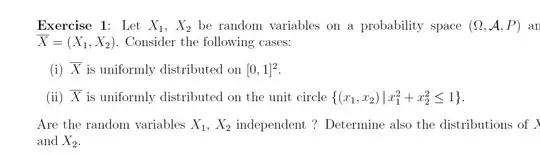
This is a problem that I am stuck at. If $X_1$ and $X_2$ are independent, it would be easier. But, the problem asks me the converse.

For (i), I suspect that $X_1$ and $X_2$ are independent. But I find no way of showing this.

For (ii), I even have no idea if $X_1$ and $X_2$ are independent...I first tried $X_1$ and $X_2$ being polar coordinates. But, I don't think they form a uniform joint distribution.

Could please anyone help me with this problem?
enter image description here

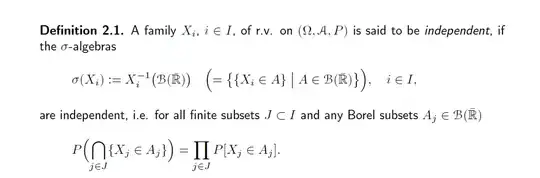
This is the definition of independent random variables.

TZakrevskiy
  • 22,980
Keith
  • 7,673

3 Answers3

3

What is the definition of the independence of two random variables? In other words, how can you mathematically determine whether two random variables are independent?

Your intuition for part (i) is correct, but you need to figure out why. The beginning step is to answer the above question.

For part (ii), suppose I generated a realization of $(X_1, X_2)$ according to the distribution specified in this part of the question. Without telling you $X_1$, I tell you that $X_2 = 0.95$. What information does this convey about the possible value of $X_1$? For example, could $X_1 = 0.5$ if $X_2 = 0.95$? Why or why not? What does this suggest about whether $X_1$ and $X_2$ are independent?

heropup
  • 135,869
  • I editted the question by adding a definition of independence I learned. And, what does it mean by realization of (X_1, X_2)? – Keith May 10 '15 at 06:25
  • What do you mean by X_2 =0.95 ? – Keith May 10 '15 at 06:26
  • 3
    Some friendly advice if you really want to learn. Don't just regurgitate a book definition. You have to understand what you read. The level of the text you are referencing is way higher than the level of understanding you seem to be at with your question; this suggests that you are not using a suitable text for what you are trying to learn, or that you have insufficient prerequisite knowledge on this topic. When I asked you for the definition of independence, I was not expecting a measure-theoretic one. It's overkill for what you actually need for this question. – heropup May 10 '15 at 06:29
  • 1
    When I say "generated a realization," what I mean is I observed some outcome of the random variable. If I have a random variable $U$ that is uniformly distributed on $[0,1]$, then a "realization" of this random variable can be generated by picking at random some real number between $0$ and $1$. – heropup May 10 '15 at 06:33
  • I have learned real analysis; and I'm taking a class some kind of "advertising" the probability theory. I first thought that probability theory is quite similiar to real analysis, just using probability measure instead of arbitrary measure. But, now I'm having much difficulty with the concept of independence...yes I acknowledge that. – Keith May 10 '15 at 06:41
2

(i) Note that uniform on the square means that $p(S) = m(S \cap [0,1]^2)$, where $m$ is the Lebesgue measure on the square (I will use the same symbol for the Lebesgue measure in the line).

Suppose $A, B \subset [0,1]$. Then $p(X_1 \in A, X_2 \in B) = p( (X_1,X_2) \in A \times B) = m(A \times B)=m(A) m(B)$. $p(X_1 \in A) = m(A)$, and similarly $p(x_2 \in B) = m(B)$. Hence $p(X_1 \in A, X_2 \in B) = p(X_1 \in A) p(x_2 \in B)$.

It should be clear that since $p(X_1 \in A) = m(A \cap [0,1])$, that $X_1$ is uniformly distributed on $[0,1]$. Similarly for $X_2$.

(ii) In this case, we have $p(S) = {1 \over \pi}m(S \cap B(0,1))$.

Let $I=[{1 \over \sqrt{2}}, 1]$. It is easy to see that $p(X_1 \in I) = p(X_2 \in I) >0$, but $p(X_1 \in I, X_2 \in I) = 0$.

Since $p(X_1 \in A) = {1 \over \pi} m((A \times \mathbb{R}) \cap B(0,1)) = {1 \over \pi}\int 1_A(x_1) 1_{B(0,1)}(x) dx$, we see that $p(X_1 \in A) = {2 \over \pi}\int_{A \cap [-1,1]} \sqrt{1-x_1^2} dx_1$, and similarly for $X_2$.

copper.hat
  • 172,524
0

You need to recall what variable independence actually means, intuitively.

$X_1$ and $X_2$ being independent means that learning about one of them gives you absolutely no information about the other.

This is obviously not the case for (ii). If you learn that $X_1=1$, you can deduce that $X_2=0$. If you learn that $X_1=0.5$, you restrict the possible values for $X_2$, and in this restricted range the distribution is different.

It's also clear that in (i) the variables are independent. The marginal distribution $X_2$ is uniform on $[0,1]$, and given any specific value of $X_1$, the conditional distribution of $X_2$ is the same.

Now it's just a matter of formalizing these intuitions based on the measure-theoretic definitions.