1

Attached below is the past examination question. I'll be presenting my thoughts and queries on it.


enter image description here


I initially thought of breaking this entire challenge down into multiple smaller ones.

  • Prove any value of $\lambda$ represents a circle through $A(7,2)$ and $B(0,9)$
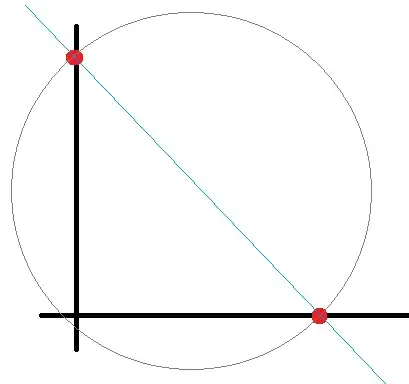
  • Sketch the circle with through points $A$ and $B$, find the midpoint which should then be the center I suppose.
  • Since the circle touches the y-axis, the radius would then be the length of the x-coordinate.

Below is a very rough sketch that came to mind: enter image description here

How should I go about tackling this question? How would one prove the initial challenge?

Juxhin
  • 605
  • You are aware that the circle in your sketch does not pass through $A$ and $B$? Also that it is unappropriately spcific in that its center is on $AB$? – Hagen von Eitzen May 16 '15 at 08:08
  • I probably am not aware, otherwise I would have depicted it in the manner I thought correct. Which is why, my doubt brought me here to seek clarification on the challenge. Instead of putting a wall in front of my face, could you kindly steer me on the right path as the young student trying to learn that I am. – Juxhin May 16 '15 at 08:10
  • @Juxhin It should be obvious the circle you drew doesn't go through the points $;A,B;$ . This isn't putting a wall in front of your face, it is just checking you understand this, because if you do not understand this then I, and perhaps others, am not going to be able to help you... – Timbuc May 16 '15 at 08:11
  • Reason I drew it like that was because the question explicitly states that it touches the y-axis. I'm not sure how it could go through and simply touch (not cross) the y-axis. – Juxhin May 16 '15 at 08:13
  • If the equation touches the y equation. The discriminant of the quadratic equation when you put $x=0$ in the circle should be 0 :) – Someone May 16 '15 at 08:14
  • "Touches" doesn't usually mean "tangentially", as you drew it. If it intersects it then it also touches it...but even if it means tangentially you didn't draw it correctly. – Timbuc May 16 '15 at 08:15
  • @Timbuc "Touches" is meant ot be tangentially here. But that refers only to thew spcific case from the second part of the question. - The circle has to pass through $A,B$ nonetheless – Hagen von Eitzen May 16 '15 at 08:16
  • Thanks everyone, I'll try to redraw the circle and updated the diagram on the question to see if I understood correctly. – Juxhin May 16 '15 at 08:17
  • @Mann - Thanks again Mann, just noticed your comment. Could you explain how that helps in regards to this question? – Juxhin May 16 '15 at 08:22
  • @Juxhin , is the y axis tangent to the circle? As it says "touches" , it usually means tangent – Someone May 16 '15 at 08:24
  • @Juxhin Also remember that if the circle is tangent to the $;y$ - axis, then the absolute value of the $;x$-coordinate of the circle's center equals the circle's center... – Timbuc May 16 '15 at 08:24
  • @Mann I am not quite sure, that is the entire question and no other information is provided so I'm not sure how to interpret it. – Juxhin May 16 '15 at 08:24
  • Well one thing you can try is, that distance of centre of circle from y axis = radius from circle, this should give you equation for $\lambda$ – Someone May 16 '15 at 08:25
  • Well, would the center be $(x-\frac{7}{2}) + (y-\frac{11}{2})$? If so then the absolute value of $x$ would be $x = \frac{7}{2}$? – Juxhin May 16 '15 at 08:29
  • No no , centre is not that your equation is $x^2+y^2+(\lambda-7)x+(\lambda-11)y+(18-9\lambda)$ – Someone May 16 '15 at 08:34

1 Answers1

2

The equation represents a circle because it is quadratic in $x$ and $y$ with equal coefficients for $x^2$ and $y^2$ and no coccurance of $xy$, so that it can easily be transformed in to $$\tag1(x-u)^2+(y-v)^2=r^2$$ (with $u,v,r$ depending on $\lambda$). We don't need to explicitly perform the transformation, we just need to ensure that we won't end up with an imaginary or zero radius. But this is clear as we can verify by plugging in that $(7,2)$ and $(0,9)$ fulfill the equation.

If the circle touches the $y$-axis then clearly $(0,9)$ is the touching point. That implies that the center of the circle is at $y=9$. That is, the $v$ in $(19$ must equal $9$. That is, the llinear term in $y$ in the original equation must be $-18y$. We find that it is $(-11+\lambda)y$, so we need $\lambda=-7$. The equation becomes $$x(x-7)+(y-9)(y-2)-7(x+y-9)=0 $$ or maybe more userfriendly $$ x^2-14x+y^2-18y+81=0$$ or to allow reading off the center and radius: $$ (x-7)^2+(y-9)^2=7^2.$$

To find the other tangent through the origin, we could reflect the point $(0,9)$ at the line through $(0,0)$ and the circle center $(7,9)$. But the reflection is easier with the point $(0,130)=9\cdot(7,9)+7\cdot(-9,7)$ because the reflection transforms it to $9\cdot(7,9)-7\cdot(-9,7)=(126,32)$. Hence the other tangent is the line through $(0,0)$ and $(126,32)$ (or as well through $(63,16)$).