2

I am looking for a continuously-differentiable function $f: U \to \mathbb{R}, U \subset \mathbb{R}^2$ which satisfies the following requirements:

  • $U$ is open set
  • $U$ is connected (right word?), i.e. $\forall P,Q \in U\ \ \exists$ continuous $\gamma: [0,1] \to U$ with $\gamma(0)=P$ and $\gamma(1)=Q$
  • $||Df(x)|| \leq 1$ for all $x \in U$ ($Df(x)$ is Jacobi Matrix)
  • There are points $P,Q \in U$ with $|f(P)-f(Q)| > ||P-Q||$

Essentially I am looking for a counter-example for the mean value theorem if U is not convex.

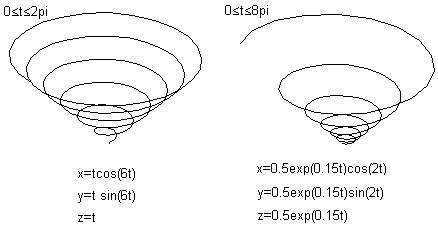
I had been thinking about trying to construct an (open) spiral like this: http://www.mathematische-basteleien.de/spiral22.gif , but can't really get it work.

Any ideas / hints / other examples?

Thanks a lot in advance!

johnnycrab
  • 1,952
  • 12
  • 14

3 Answers3

0

Consider the domain $U \subset \mathbb{R}^2$ obtained from the annulus $1 <r <2$ by removing the real half axis $[0, \infty)$. Consider the function $f(x,y) = \text{arg}( x + i y)= \phi$ in polar coordinates. $f$ maps $U$ onto $(0,2 \pi)$. The gradient of $f$ is $\nabla \arctan(y/x) = (- \frac{y}{x^2 + y^2}, \frac{x}{x^2 + y^2})$ so its norm is $<1$. Check to see that points very close by in the distance from $\mathbb{R}^2$ have values of $f$ differing by about $2 \pi$.

The point is that the distance from $\mathbb{R}^2$ is in general not the intrinsic distance ( the infimum of lengths of paths ) if $U$ is not convex. However, for that intrinsic distance the inequality will still hold, in fact you can check on this example.

orangeskid
  • 53,909
0

Consider $$h(t)=\begin{cases}0&\text{if }t\le 0\\e^{-1/t}&\text{if }t>0\end{cases}$$ which is a smooth(!) function. Then $$ g(t)=\frac{h(t+1)\cdot t+h(1-t)\cdot 0}{h(t+1)+h(1-t)}$$ is a function that smoothly switches from constant $g(t)=0$ (for $t<-1$) to $g(t)=t$ (for $t>1$). You may also check that $|g'(t)|\le 1$. Now let $$f(x,y)= \operatorname{sgn}(y)\cdot g(x)$$ on the open set $$U=\mathbb R^2\setminus\bigl([-1,\infty)\times \{0\}\bigr).$$ Then check points $P=(x,y)$ and $Q=(x-y)$ with $x\gg 0$ and $0<y\ll x$: $$ |f(P)-f(Q)|=2x\quad \gg\quad \|P-Q\|=2y.$$

-1

Answer was provided before edit required continuity.

F(x,y)=0 elsewhere

F(y,y^2)=1

Now consider the origin. All gateaux derivatives exist but the function isn't even continuous.

RowanS
  • 1,086