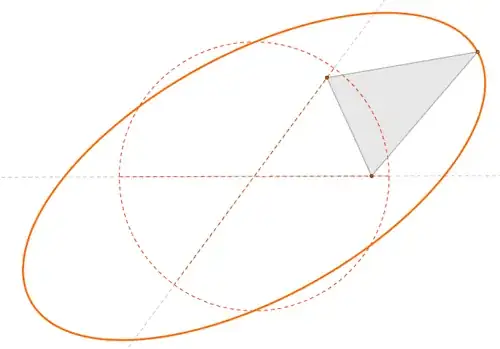
We need to prove the following: when two vertices of a fixed triangle slide along two arms of a fixed angle, the locus described by the third vertex is an ellipse.
In the figure all the letters excepting $t$ and $P(x,y)$ are data of the problem; the angle $t$ determines the position of the vertex $P(x,y)$ so we choose $t$ as a parameter to be eliminated in order to find out the searched locus.
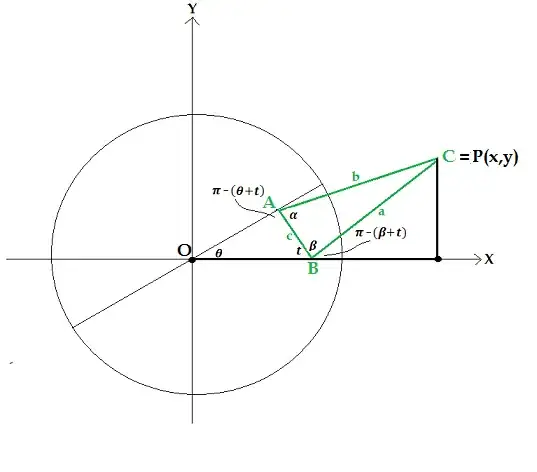
We have $$OB=\frac {c\sin (\theta+t)}{\sin\theta}$$ then
$$x= \frac {c\sin (\theta+t)}{\sin\theta} \,–\, a\cos(\beta+t)$$
$$y=a\sin(\beta+t)$$
i.e. $$x=A\cos t-B\sin t$$
$$y=C\cos t+D\sin t$$
Where $$A=c-a\cos\beta$$$$B=c\cot \theta +a\sin\beta$$
$$C=a\sin\beta$$ $$D=a\cos\beta$$
Solving for $\sin t$ and $\cos t$ and because of $$\sin^2 t+\cos^2 t=1$$ it follows
$\det^2\begin{pmatrix}x&-B\\y&D\\ \end{pmatrix}$+$\,\det^2\begin{pmatrix}A&x\\C&y\\ \end{pmatrix}=$$\,\det^2\begin{pmatrix}A&-B\\C&D\\ \end{pmatrix}$
Thus $$(Dx+By)^2+(Ay-Cx)^2=(AD+BC)^2$$i.e.$$(C^2+D^2)x^2+(A^2+B^2)y^2+2(BD-AC)xy=(AD+BC)^2$$ This is a quadratic form of two real variables in which coefficients of $x^2$ and $y^2$ are both positive and distinct. This shows that the locus is an ellipse.