I feel like this should be really easy, but I'm not sure if I'm doing it correctly so I'm going to give it a go here, and if I'm not very good at maths (I'm not) then you can hopefully correct me!
Suppose I want to paint the surface of a parabolic dish, how would I calculate that area?
To make it slightly more clear, this type of thing:
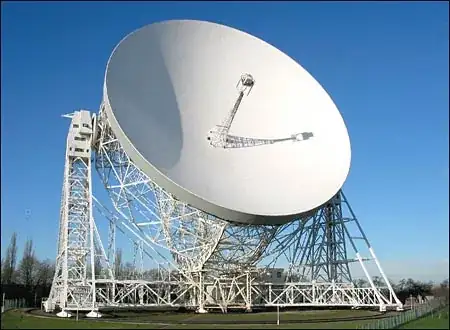
Where a cross section of it would be some function:
$y = a x^2\quad$ (1)
from $y = 0$ (what I will call the vertex) to some point $y=h$ at the opening of the dish.
I thought then that the radius at a certain height would be:
$r = \sqrt{\frac{y}{a}}\quad$ (2)
and therefore the radius at the top, $d$, would be given by the equation:
$d = \sqrt{\frac{h}{a}}$
or in other words:
$a = \frac{h}{d^2}$
So I rewrote (1) and (2) using that:
$y = \frac{h}{d^2} x^2 \quad$ (3)
$r = \sqrt{\frac{d^2y}{h}}\quad$ (4)
Now I can find the areas of small strips around the dish, and integrate. And this is where I get a bit stuck. I initially did the area of rectangles, but of course the strips (if you unfold them) are actually like this:
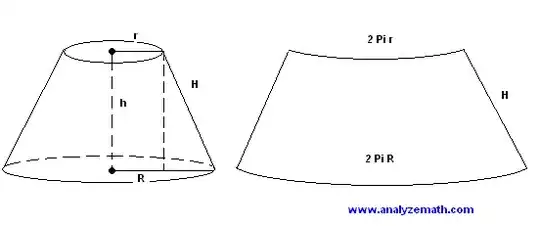
(of course they're not exactly like that because that's a cone and we have a dish, but they're similar in how they're both not rectangles for almost the same reason, if that makes sense)
And I have no idea how to express that area mathematically...


