17

I have a square that's $10\mathrm{m} \times 10\mathrm{m}$. I want to cut it in half so that I have a square with half the area. But if I cut it from top to bottom or left to right, I don't get a square, I get a rectangle!

I know the area of the small square is supposed to be $50\mathrm{m}^{2}$, so I can use my calculator to find out how long a side should be: it's $7.07106781\mathrm{m}$. But my teacher said I should be able to do this without a calculator. How am I supposed to get that number by hand?

Larry Wang
  • 9,513

3 Answers3

33

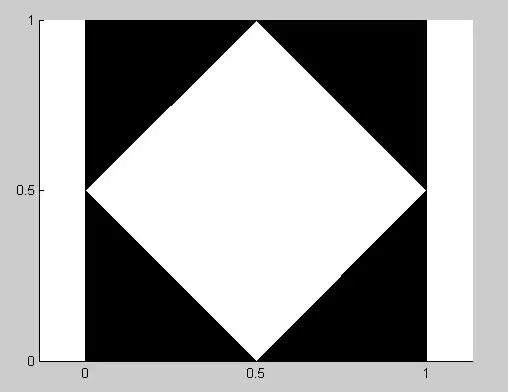
Does this give you any ideas?

alt text

Jason S
  • 3,109
  • 2
    Wow, looking at the picture, I see that the square is evenly split into the black and white areas. I wasn't convinced at first, but then I printed out the picture and saw that the four black triangles can be 'folded' over to cover the small white square perfectly. – Larry Wang Jul 20 '10 at 23:23
  • yup, each of the quadrants of the outer square is split in half. – Jason S Jul 20 '10 at 23:24
  • 1
    ...of course, if you're working in wood and the direction of the grain is important, this method would mess that up. – Jason S Jul 20 '10 at 23:25
  • 1
    This is exactly the same figure that Plato used in his dialogue Meno (search for the first instance of "Boy", and read from there) to answer the very same question as the OP asked here. – Per Erik Manne Oct 17 '12 at 11:10
29

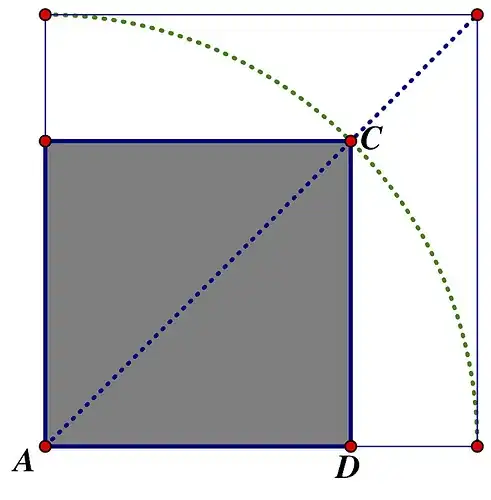
Take a pair of compasses and draw an arc between two opposite corners, centred at another corner; then draw a diagonal that bisects the arc. If you now draw two lines from the point of intersection, parallel to the sides of the square, the biggest of the resulting squares will have half the area of the original square.

Here's an illustration:

Illustration of the method

  • 3
    Really? Why does that work? – Larry Wang Jul 20 '10 at 21:47
  • This leaves me with a square with area (7-7 sqrt(2))^2; am I doing this right? – Justin L. Jul 20 '10 at 21:59
  • 5
    It works because the diagonal of the inner square is equal to the side of the outer square. The ratio of the diagonal to the side of any square is root 2, so the ratio of the diagonals of the two squares is root 2, so the ratio of the areas is 2. – Neil Mayhew Jul 20 '10 at 22:11
  • You lost me at that last step. What does the ratio of the diagonals have to do with anything? – Larry Wang Jul 20 '10 at 22:29
  • Since the one-dimensional "size" of the square is related to its two-dimensional size (area) as a square root, and the diagonal is one-dimensional, the ratio between the diagonals of two squares is the square root of the ratio of their areas. Hence, if the ratio of diagonals is root 2, then the ratio of their areas is 2, i.e. one is twice the size of the other. – Will Vousden Jul 20 '10 at 22:44
  • 2
    http://farm5.static.flickr.com/4082/4813660948_8e8caa2ec9.jpg should be a picture to match this answer. Because C is on the circle with center at A and passing through the vertices adjacent to A, the length of AC is equal to the length of a side of the square. ∠CAD has measure 45 degrees, so AD and DC both have length 1/sqrt(2) times the length of a side of the original square, so the shaded square has half the area of the original square. @Will, feel free to edit my image into your answer. – Isaac Jul 21 '10 at 00:03
  • 3
    While the original post mentions only needing one square of half the size, I'm left wondering if there's a nice dissection of the remaining 'L' into some number of constructible pieces that can be reassembled into a second square... – Steven Stadnicki Nov 26 '11 at 23:09
  • 4
    @Steven, indeed there is. Cut along the diagonal through C and its perpendiculars on both sides, giving two trapezoids and two isosceles right triangles. Join the two trapezoids like a miter joint, and fill in the square hole using the triangles. (I'd post a picture, but I don't have any drawing software installed on this machine...) –  Nov 27 '11 at 01:07
  • @RahulNarain : your description works perfectly for me. Thank you! – Steven Stadnicki Nov 27 '11 at 19:11
  • @LarryWang To see that this works, we just need to show that it's the same size as the square in Jason S's answer. To do that, compare the lengths of the diagonals of the two squares; they're both equal to the sidelength of the original square ($\rm10m$). – Akiva Weinberger Feb 10 '17 at 16:18
0

One more approach:

Consider a square of side length a. Label it A,B,C and D, counterclockwise starting from the left lower corner (A).

Draw the diagonals intersecting at M, at right angles, bisecting each other.

Pythagoras: $a^2 +a^2 = 2a^2$.

Length of diagonal = $√2 a$.

Length AM = length BM = $(1/2) √2 a$.

As mentioned before the diagonals bisect each other, and intersect perpendicularly.

These are 2 sides of the new square with half the area of the original square.

Area of reduced square : Length AM × length BM = $(1/2) a^2$.

To complete your reduced square draw a parallel to AM through B, and a parallel to BM through A.

Peter Szilas
  • 20,344
  • 2
  • 17
  • 28