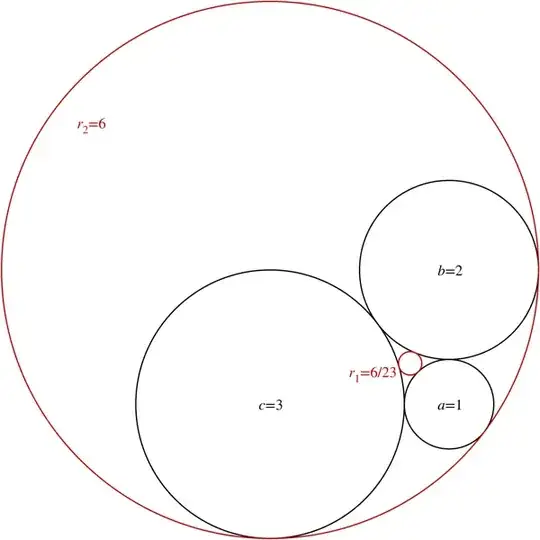
Using Descartes' Theorem, for each of the circles that touch the three,
$$
\left(\frac1a+\frac1b+\frac1c+\frac1{r_k}\right)^2=2\left(\frac1{a^2}+\frac1{b^2}+\frac1{c^2}+\frac1{r_k^2}\right)
$$
Subtracting these equations for $r_1$ and $r_2$ gives
$$
\left(\frac1{r_1}-\frac1{r_2}\right)\left(\frac2a+\frac2b+\frac2c+\frac1{r_1}+\frac1{r_2}\right)=2\left(\frac1{r_1^2}-\frac1{r_2^2}\right)
$$
Dividing both sides by $\frac1{r_1}-\frac1{r_2}$ gives
$$
\frac2a+\frac2b+\frac2c+\frac1{r_1}+\frac1{r_2}=2\left(\frac1{r_1}+\frac1{r_2}\right)
$$
and finally,
$$
\frac2a+\frac2b+\frac2c=\frac1{r_1}+\frac1{r_2}
$$
This looks different, but the externally tangent circle has a negative bend ($\frac1r$), so correcting for that, we get
$$
\bbox[5px,border:2px solid #C0A000]{\frac2a+\frac2b+\frac2c=\frac1{r_1}-\frac1{r_2}}
$$
where $r_2$ is the radius of the externally tangent circle.
Example:
Let $a=1$, $b=2$, and $c=3$. Using Descartes' Theorem, we compute
$$
r_1=\frac{6}{23}\quad\text{and}\quad r_2=6
$$
so that
$$
\frac21+\frac22+\frac23=\frac{23}{6}-\frac16
$$