1

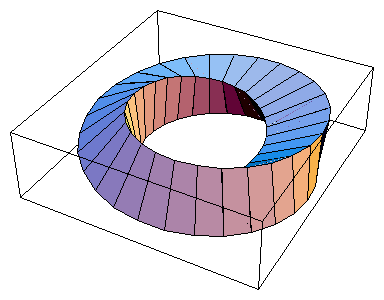
In the below two images you see one with three lines leaving point A each 120 degrees apart and a umbilic torus made from twisting a triangle around a circle.

I have tried to construct an umbilic torus with, rather than a triangle, the shape below. I am doing this with the intent of investigating, if utilizing the shape below, can you bring the umbilic torus diameter to a length infinitesimally larger than the length of segment A:B without causing the umbilic torus to intersect itself.

Unfortunately my skills in blender are not adequate enough for me to create this and I do not have any other software on my computer that would allow me to.

Does anyone know another way of answering this?

enter image description here

http://www.mathconsult.ch/static/pubs/illumath/IME22.gif

http://www.mathconsult.ch/static/pubs/illumath/IME22.gif

Joe
  • 534
  • Are you sure about the name of the surface you are describing? This doesn't seem to be what you're talking about, and it's all I could find looking for "umbilic torus"... – A.P. Nov 14 '15 at 17:29
  • More importantly, what construction do you have in mind? Depending on how many times you twist the triangle (or your shape) it could be more or less easy to answer to your question. Indeed, note that every integer multiple of $1/3$ of a turn would give a surface, but for every even multiple you will have two opposite triangles with vertices facing each other. – A.P. Nov 14 '15 at 17:46
  • 1/3 for every time it goes around. like the picture – Joe Nov 15 '15 at 23:39
  • One last question: how do you define the "diameter" of the torus? If you mean the distance between the "copies" of $A$ then the answer is easily seen to be yes. If you mean the distance between the two copies of your shape in any section along the rotation axis, then most likely the answer is no. If you mean the distance between the outermost points of the revolution surface, then the answer is most definitely no. – A.P. Nov 16 '15 at 00:15

0 Answers0