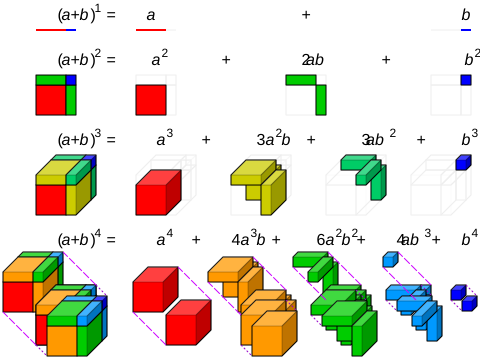
How does $ \binom{n}{k} $ 'n choose k' get involved with coefficient of $ (a+b)^n $. Is there any intuitive geometrical picture (interpretation) that it seems obvious?
Asked
Active
Viewed 1,396 times
4

S L
- 11,731
-
1This question seems to be related: Binomial Coefficients in the Binomial Theorem - Why Does It Work Question – Martin Sleziak Jun 11 '12 at 13:03
-
Ah thanks ... !! i guess it's exactly what i'm looking for – S L Jun 11 '12 at 13:04
-
3Picture an $n$-dimensional cube (that is the hard part) with side length $a + b$ and divide it up... this is not easy to do beyond $n = 3$ but it is a good exercise anyway. – Qiaochu Yuan Jun 11 '12 at 14:07
-
How do I divide it?? .. i mean how many smaller cubes am i going to have?? – S L Jun 11 '12 at 17:01
-
2There is a very good picture under "geometric explanation" in the Wikipedia article on the binomial theorem here: http://en.wikipedia.org/wiki/Binomial_theorem – Jair Taylor Jun 14 '12 at 19:01
-
Thanks ... you could have added an answer ... everyone would notice – S L Jun 14 '12 at 19:15
3 Answers
8
Hint: Imagine writing $(a+b)^n$ as $(a+b)(a+b)\dots(a+b)$, and then multiplying out all the brackets. Ask yourself how many ways you can get a term involving $a^kb^{n-k}$.

Old John
- 19,569
- 3
- 59
- 113
5
Expanding on what Old John wrote, it might help to consider a "noncommutative" version of the binomial theorem. $(a+b)^n = (a+b)(a+b)...(a+b)$ is going to have $2^n$ terms. Each of the $2^n$ words of length $n$ consisting of the letters $a$ and $b$ will occur exactly once. If you identify words via commutativity of multiplication, you will see there are $\binom{n}{k}$ words in the equivalence class of $a^{n-k}b^k$.

Seth
- 9,393
- 1
- 27
- 64
4
Here is how you visualize binomial theorem https://upload.wikimedia.org/wikipedia/commons/4/47/Binomial_theorem_visualisation.svg

bsdshell
- 1,509