1

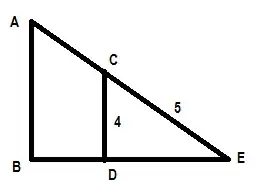
In this diagram AB and CD are both perpendicular to BE.If EC=5 and CD=4. What is ratio of AB to BE ?
enter image description here

How would i go about solving this triangle (without trigonometric ratios). I could only get DE=3 using Pythagoras theorem and was stuck after that. How would i calculate BD ? Do i make BC ? Suggestions ?

Edit: The answer is 4:3.

MistyD
  • 1,655

2 Answers2

1

The two triangles $ABE$ and $CDE$ are similar. They have the same shape, You can think of $\triangle ABE$ as $\triangle CDE$, after you have put $\triangle CDE$ into a copier and scaled it up somewhat.

So the ratio of $AB$ to $BE$ is the same as the ratio of $CD$ to $DE$. But you calculated $DE$, so you know this ratio.

André Nicolas
  • 507,029
0

By Thales' theorem we have $\frac{CD}{AB}=\frac{DE}{BE}$ and so $\frac{AB}{BE}=\frac{CD}{DE}$.
We know $CD=4$ and by the Pythagorean theorem in $CDE$ we get $DE=3$.
So $\frac{AB}{BE}=\frac{4}{3}$.

JBC
  • 2,376
  • Hi JBC thanks for the great answer. I am not really familiar with Thales theorem but i did read a little about. From What i could tell so far is , if we want to apply Thales on this figure it will be AC/CE = BD/DE. How did you come up with CD/AB = DE/BE – MistyD Jun 19 '12 at 22:37
  • Let $ABC$ a triangle, let $D\in(AB)$ and $E\in(AC)$ if $(DE)$ and $(BC)$ are parallel, then $\dfrac{AD}{AB}=\dfrac{AE}{AC}$ and $\dfrac{AD}{AB}=\dfrac{DE}{BC}$. See http://fr.wikipedia.org/wiki/Fichier:Thales_theorem_1.svg and http://fr.wikipedia.org/wiki/Fichier:Thales_theorem_2.svg for figures. – JBC Jun 19 '12 at 22:43