Consider the dynamical system defined by
$$\overset{\circ}{x} = x\cdot g(x),$$
where
$$g(x) = \frac{r}{\alpha - x};\quad r,\alpha\in\mathbb{R}^+.$$
I am asked for a biological interpretation of this system, with $x(t)$ representing a population with a growth rate of $g(x)$. Everything would be easier if $g(x)$ were continuous in $[0,+\infty)$, which is clearly false for every value of $\alpha$ (here's a plot of $g(x)$ for $r = 1$, $\alpha = 4$):
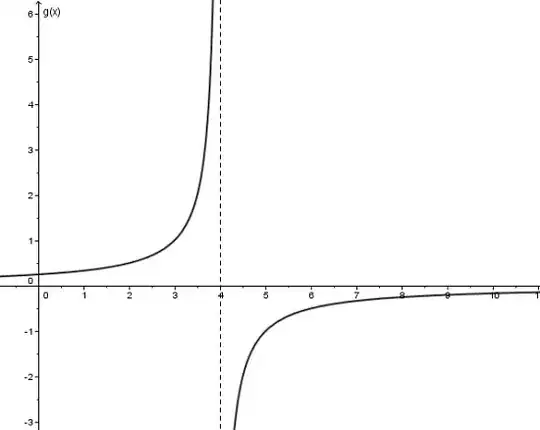
Now, I have two main questions:
- It would look like $\alpha$ is not a fixed point, because it is never a root of $\overset{\circ}{x}$. Yet, sketching the corresponding vector field on the real line tells us that, if we start from an initial condition $x_0<\alpha$, we end up approaching $\alpha$ as $t\to\infty$; similarly, $x(t)\to\alpha$ if we start from an initial condition $x_1>\alpha$. Can trajectories really approach a point that's not an equilibrium for the system?
- What on earth happens if our initial condition is exactly equal to $\alpha$? The growth rate $g(x)$ would not even be defined for that value of $x$, so how does this have a biological meaning? In particular,$$\lim_{x\to\alpha^-}g(x) = +\infty;$$doesn't this mean that, if we start from an initial condition that is close enough to $\alpha$ (from the left side), our solution is destined to reach infinity incredibly fast? The growth rate would be pretty big after all, and it would grow even more as we get closer to $\alpha$. But doesn't this contradict the fact that $x(t)\to\alpha$ as $t\to\infty$, for all initial conditions $x_0$?


