0

$$\frac{(x+1)^2}{16} + \frac{(y-2)^2}{9} = 1.$$

I just started conics, but I thought you would multiply both sides by $16$ and then $9$ and then expand, which would get you $x^2 +y^2+2x-4y+5$.

Both signs are the same, but the foci is supposed to be: $(−1 \pm \sqrt{7},2)$, which I don't get.

I thought it was supposed to be a circle. both squared variables are multiplied by the same number and have the same signs.

I tried to identify it off of:

Are both variables squared?

    No: It's a parabola.
    Yes: Go to the next test....
    Do the squared terms have opposite signs?

        Yes: It's an hyperbola.
        No: Go to the next test....
        Are the squared terms multiplied by the same number?

            Yes: It's a circle.
            No: It's an ellipse.

Gotten from purplemath: http://www.purplemath.com/modules/conics.htm

CrewdNBasic
  • 307
  • 1
  • 2
  • 6

2 Answers2

1

It's not a hyperbola. It's an ellipse.

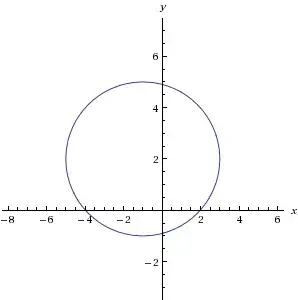
In fact, here it is:

enter image description here

Let's go a bit further and see what we can say about it, since you just started conics and all. It's equation is $\dfrac{(x+1)^2}{16} + \dfrac{(y-2)^2}{9} = 1$.

The standard form is $\dfrac{x^2}{r_x^2} + \dfrac{y^2}{r_y^2} = 1$, where $r_x$ is the length of the $x$-radius and $r_y$ is the length of the $y$-radius. If $r_x > r_y$, then $r_x$ is called the length of the major axis and $r_y$ is called the length of the minor axis. The $+1$ with the $x$ moves the center to the left by $1$,and the $-2$ with the $y$ moves the center up by $2$. That's why the center is at $(-1,2)$ in the graph above.

  • 2
    Sneaky plotting software, scaling the axes non-uniformly to make the ellipse look like a circle. :) – Ilmari Karonen Jun 29 '12 at 21:02
  • I know - it's tricky like that. – davidlowryduda Jun 29 '12 at 21:03
  • thanks. don't ellipses squared terms have to be multiplied by different numbers? – CrewdNBasic Jun 29 '12 at 21:05
  • @CrewdNBasic: I don't know what you mean. If you're referring to the $1/9$ and $1/16$ here, that depends on whether you consider a circle to be an ellipse or not. (I say it is, but one never knows how schools teach these things) – davidlowryduda Jun 29 '12 at 21:06
  • i meant the coeffient of the x and y squared. I was going off of this: Are both variables squared?
        No: It's a parabola.
        Yes: Go to the next test....
        Do the squared terms have opposite signs?
    
            Yes: It's an hyperbola.
            No: Go to the next test....
            Are the squared terms multiplied by the same number?
    
                Yes: It's a circle.
                No: It's an ellipse.
    

    gotten from purplemath: http://www.purplemath.com/modules/conics.htm
    – CrewdNBasic Jun 29 '12 at 21:18
0

If you take $$\frac{(x+1)^2}{16} + \frac{(y-2)^2}{9} = 1$$ and multiply both sides by $16$ and then $9$ you get $$9(x+1)^2 + 16(y-2)^2 = 144.$$ If you expand you get $$9x^2+18x+16y^2-64y-71 =0$$ which is not what you had.

In fact your equation is of a ellipse centred at $(-1,2)$ with a horizontal semi-major axis of $ \sqrt{16} =4$ and a vertical semi-minor axis of $ \sqrt{9} = 3$.

Henry
  • 157,058
  • Thanks!!!!!!!!!!! I was like how is that different than a regular fraction, but 9 goes to one fraction, and the 16 goes to the other. had a brain lapse and treated everything like it was getting cancelled out. – CrewdNBasic Jun 29 '12 at 22:44