I have an Angle Chasing based approach to this problem. It is as follows;
Let $M$ be the midpoint of Line Segment $\overline{BC}$, we construct a line parallel to $BC$ through $D$, and let it intersect $AB$ and $EC$ at $F$ and $G$.
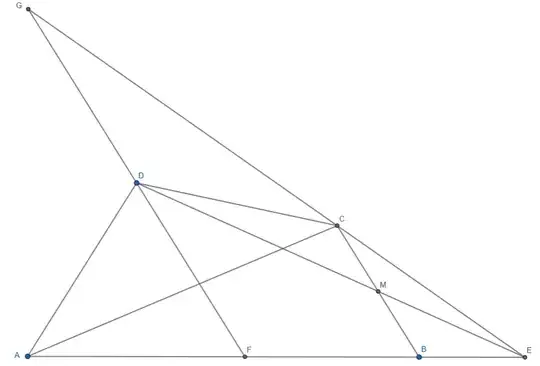
We know that $\angle AFD=\angle ABC=\angle BAD=\angle FAD$. Hence, $\triangle ADF$ is isosceles, and we must have $DA=DF$. We let $DA=DF=DC=x$.
We know by the Basic Proportionality Theorem that;
$$\frac{FD}{DG}=\frac{BM}{MC}=1$$
$$\implies FD=DG.$$
Since $FD=x$, we must have $DG=x$, as well. Now, we know that $DA=DF=DC=DF=x$, and thus $AFCG$ is a lies on a circle centered at $D.$ Hence, $AFCG$ is a Cyclic Quadrilateral.
Consider $\angle ACG$ and $\angle AFG$, since the two angles are inscribed in the same arc ${AG}$ of circle $AFCG,$ we know that $\angle ACG=\angle AFG.$
Hence, we know that;
$$180^{\circ}-\angle ACG = 180^{\circ}-\angle AFG$$
$$\implies \angle ACE= \angle GFE=\angle CBE$$
$$\implies \angle ACE=\angle CBE.$$
Consider triangles $\triangle ACE$ and $\triangle CBE,$ we know that they share an angle at $E,$ and $\angle ACE=\angle CBE.$ Hence, the two triangles are similar by $\text{AA Similarity}$ and we thus have;
$$\frac{EB}{EC}=\frac{EC}{EA}$$
$$\implies EB\cdot EA=EC^2,$$
which is what you needed. But just to continue, we know by similarity that $\angle BCE=\angle CAE,$ let this angle be $y.$
We know that $\angle BAD=\angle ABC,$ but since $\angle BAD=\angle BAC+\angle CAD,$ and $\angle ABC=\angle BCE+\angle BEC,$ we must have;
$$\angle BAC+\angle CAD=\angle BCE+\angle BEC$$
$$\implies y+\angle CAD=y+\angle BEC$$
$$\implies \angle CAD=\angle BEC$$
as required.