I have a right triangle $ABC$. I am given the coordinates of the two points $A(x_1, y_1)$ and $C(x_2, y_2)$. Given points $A$ and $C$, I want to determine the coordinates of $B$. I know there are two solutions for this. I want to find them both.
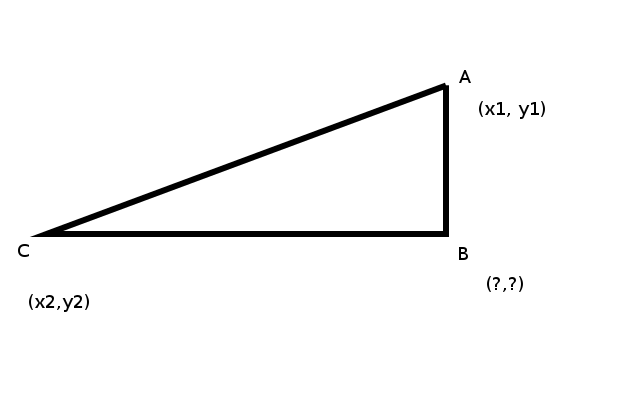
I have a right triangle $ABC$. I am given the coordinates of the two points $A(x_1, y_1)$ and $C(x_2, y_2)$. Given points $A$ and $C$, I want to determine the coordinates of $B$. I know there are two solutions for this. I want to find them both.
There are many solutions for $B$:
Draw a circle trough the points $A$ and $C$, with diameter $|AC|$, then all points on that circle except $A$ and $C$ are solutions
This is called Thales' theorem

We can find the points on this circle by first finding the equation of that circle with center
$$O=\dfrac{A+C}{2}$$
Taking your example: $A=(4,3)$ and $C=(2,1)$ we find that
$$O=\dfrac{(4,3)+(2,1)}{2}=\dfrac{(6,4)}{2}=(3,2)$$
And the radius of the circle is $|AO|=\sqrt{1^2+1^2}=\sqrt{2}$
So the equation of that circle is $$(x-3)^2+(y-2)^2=2$$
All points $B=(x,y)$ that satisfy this equation, except $A$ and $C$ make a right triangle with your given points.
Let's solve the equation for $y$:
$$y=\pm \sqrt{2-(x-3)^2}+2$$
So choose a value for $x$ but make sure the part under the square root will not be negative, and this will give you two valid values for $y$!
Example: choose $x=3$ then the formula gives $y=\pm \sqrt{2}+2$ so $$B=(3,\sqrt{2}+2)$$
Is one of many solutions.

Practically... between two push pins placed $ d= 2 \sqrt 2 $ distance apart press two sides (not hypotenuse) of a set square or triangle touching and same time rotating it. Notice that the vertex making a right angle can be moved to many points, in fact around a circle of diameter $d$.


