1

I have read that in contrast of the thin-plate splines, B-splines are locally controlled, which makes them computationally efficient even for large number of control points.

I didn't understand what does it mean by saying that B-splines are locally controlled. Can anyone help with this?

Gina
  • 353

1 Answers1

1

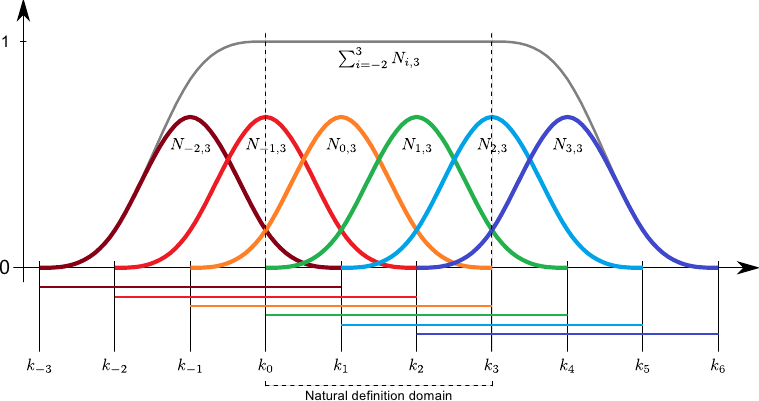
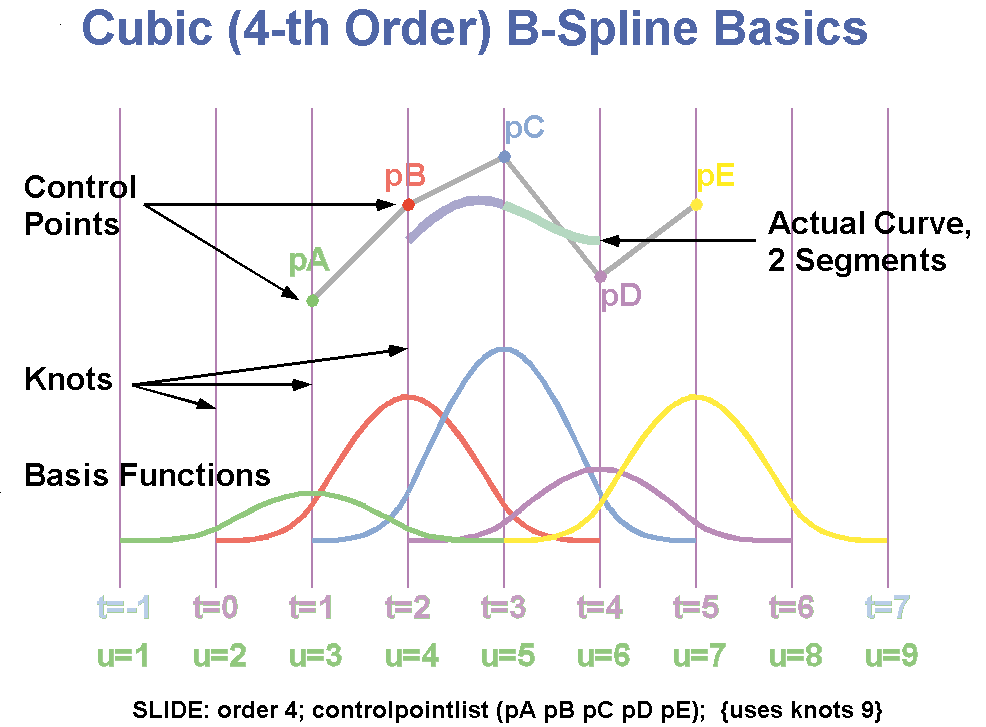
It means that value of B-spline at a point depends just on few control points localized nearby. And vice versa, if you modify a control point, or coefficient of one basisfunction it will affect just some local nighborhood.

In case of cubic B-spline (which is most common e.g. in computer graphics ) in 1D value $f(x)$ at any point depends on value of 4 control points (resp. basisfunctions ) as

$ f(x) = \sum_{i=1..3} \alpha_i \phi ( x - i ) $

It is nice visible here http://www.brnt.eu/phd/ucbs-basis.png or here http://www.cs.berkeley.edu/~sequin/CS284/IMGS/bsplinebasics.gif

  • Thank you very much. Your answer was very helpful. I would like to clarify one more thing. In case of cubic B-splines in 1D any point depends on value of 4 control points regardless how coarse or fine is the grid? It's always affect 4 control points? – Gina Mar 24 '16 at 10:31
  • Also here: http://www.brnt.eu/phd/ucbs-basis.png the ks are the points affected? Because for each colorful function correspond 5 k values. – Gina Mar 24 '16 at 10:36
  • yes, if you sample an interval of $x$ by finer grid than basis function $\phi(x)$ has smaller extend (are more contracted, perhabs I should write $\phi_i( (x/L) - i)$ where $L$ is the sampling step size ) so at any point $x$ just 4 of them are non-zero. But because they are more contracted, they are sharper, so you can reproduce finer details of your function which you want to approximate. – Prokop Hapala Mar 24 '16 at 13:00