Let $f$ be a function from set $A$ to set $B$, denoted $f: A \to B$. The set $A$ is called the domain of $f$. The set $B$ is called the codomain of $f$. The set $f(A) = \{f(a) \mid a \in A\}$ is called the range of $f$. A function is said to be surjective when the codomain is equal to the range, that is, if $f(A) = B$.
Example. Let $A = \{a, b, c, d\}$. Let $B = \{1, 2, 3, 4\}$. The function $f: A \to B$ defined by $f(a) = 1$, $f(b) = 2$, $f(c) = 3$, $f(d) = 4$ that sends each letter to its position in the alphabet is surjective since $f(A) = \{f(a), f(b), f(c), f(d)\} = \{1, 2, 3, 4\} = B$.
Example. Let $A = \{a, b, c, d\}$. Let $B = \{1, 2, 3, 4\}$. The function $g: A \to B$ defined by $g(a) = 1$, $g(b) = 2$, $g(c) = 3$, $g(4) = 1$ is not surjective since $g(A) = \{1, 2, 3\} \subsetneq B$ because the element $4 \in B$ is not in the range $g(A)$.
A function $f: \mathbb{R} \to \mathbb{R}$ has domain and codomain equal to the set of all real numbers. It is surjective if the range of the function is also the set of all real numbers.
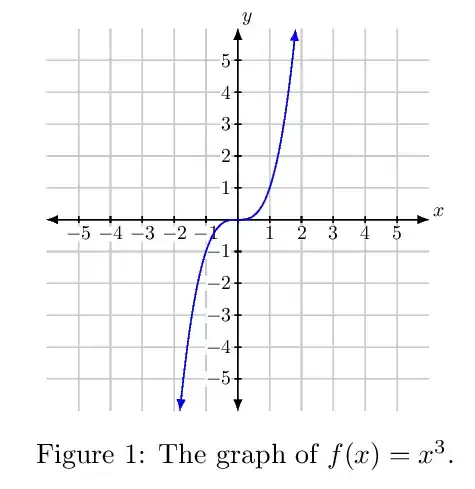
An example of a surjective function $f: \mathbb{R} \to \mathbb{R}$ is the function $f(x) = x^3$ since its range is $\mathbb{R}$.
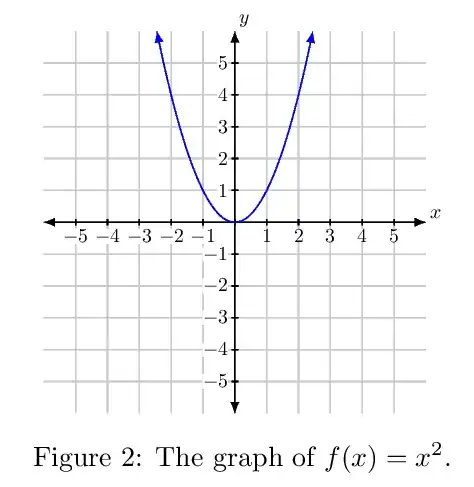
An example of a function $f: \mathbb{R} \to \mathbb{R}$ that is not surjective is $f(x) = x^2$ since its range $[0, \infty) = \{x \in \mathbb{R} \mid x \geq 0\}$ does not include any negative real numbers.
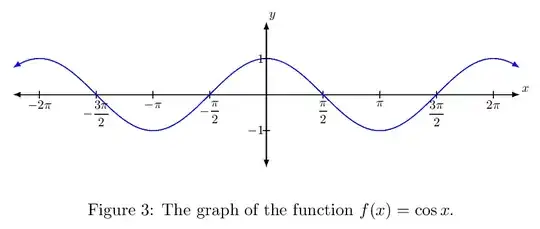
The question is asking you whether the function $f: \mathbb{R} \to \mathbb{R}$ defined by $f(x) = \cos x$ is surjective, that is, it is asking you whether the range of $f(x) = \cos x$ is the set of all real numbers.