Function $f$ is said to be even if $f(-x)=f(x)$ for all such $x$ that both sides of equality are defined. From graphic point of view even functions are symmetric about the y-axis.
Function $f$ is said to be odd if $f(-x)=-f(x)$ for all such $x$ that both sides of equality are defined.
Now let $f$ be the function from your sketch (with 3 humps). Obviously it's neither odd nor even. But if we consider function $g$ obtained from $f$ by left shift to meet the following plot:
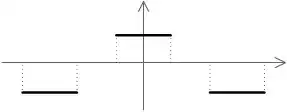
we'll see that $g$ is even. As you may observe, there's no such shift that would make function $f$ odd. However by some shifts you can obtain such function $h$ that its restriction to an interval $(-a,a)$ for some $a$ would be odd. The most meaningful ways to do this are like this
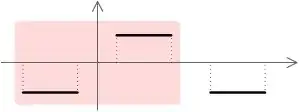 or like this
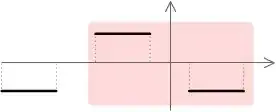
Pink background indicates the chosen interval.


