The circle equations have no coefficient for $y^1$, and also putting $ y=-y$ there is no change. We can delete $y^2$ term to see ordering of roots on x-axis.So both circles are centered on x-axis.
Product of roots (power of circles = $c$ ) is same. Center distances are half sum of roots.$ -\lambda/2, - \mu/2 $ and product of roots $c>0$.
If $\mu$ circle are to be inside $\lambda $ circle,
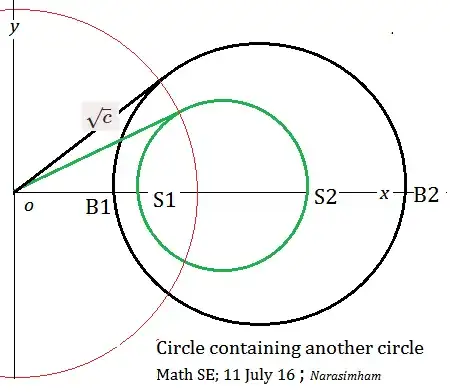
the roots need to be ordered in positive x-direction left to right( where $B$ is for Big circle and $S$ for small circle ) in the following manner:
$$ x^2 + \lambda x + c =0,\, x^2 + \mu x + c =0,\, $$
$$ B1= \frac{ -\lambda - \sqrt { \lambda^2-4c} }{2} ,S1=\frac{ -\mu - \sqrt { \mu^2-4c} }{2} ,$$
$$ S2=\frac{ -\mu + \sqrt { \mu^2-4c} }{2},B2=\frac{- \lambda + \sqrt { \lambda^2-4c} }{2} ; $$
as also shown in figure.
Algebraic criterion for such geometric ordering is :
$$ (S1-B1)( B2-S2) >0$$
or
$$ (S1 B2+S2 B1) - (S1 S2+B1 B2) >0 $$
Simplfying (omitting intermediate steps),
$$ \lambda \mu > \sqrt{\lambda^2-4 c}\, \sqrt {\mu^2 - 4 c} +4 c $$
The quantity under radical sign is positive discriminant of quadratic equation because there are two distinct real roots for each $\lambda$ and $\mu$ circles as given above.
$ c>0$ for positive power of circles shown, so
$$ \lambda \mu > 0. $$
This means that wlog both circles can be reflected about $y$axis.


