$\def\bbA{\mathbb{A}}
\def\fra{\mathfrak{a}}
\def\jn{\operatorname{JN}}
\def\an{\operatorname{AN}}
\def\frm{\mathfrak{m}}$Let's call the statement in italics from the OP the Jacobson Nullstellensatz, and abbreviate it as $\jn(R,S)$, for a given Jacobson ring $R$ and a finitely generated $R$-algebra $S$.
Let $k$ be any field, and denote $\bbA_k^n=k^n$ to the $n$-dimensional classical affine space over $k$. For each subset $S\subset k[T_1,\dots,T_n]$, denote $V(S)=\{x\in\bbA_k^n\mid f(x)=0,\;\forall f\in S\}$ to the vanishing set of $S$. On the other hand, for each subset $X\subset\bbA_k^n$, denote $I(X)=\{f\in k[T_1,\dots,T_n]\mid f(x)=0,\;\forall x\in X\}$ to the vanishing polynomial ideal of $X$. Then, for any ideal $\fra\subset k[T_1,\dots,T_n]$, it is not difficult to verify that $I(V(\fra))\supset\sqrt{\fra}$.
Now suppose that $k$ is algebraically closed field (we will assume so for the rest of the post). Then it holds that $I(V(\fra))=\sqrt{\fra}$. Let's call algebraic Nullstellensatz to this assertion, and abbreviate it as $\an$.
I claim that
$$
\jn(k,k[T_1,\dots,T_n])\iff\an.
$$
Note: of course this equivalence is just a tautology, these assertions are true mathematical statements by their own right. What I actually mean with this logic equation is that there is a direct proof of each of the claims using the other one. This justifies why it makes sense to call $\jn(R,S)$ the “general form of the Nullstellensatz” (as they do in the links 2, 3 from the OP).
Let's give the argument. We start with an easy
Lemma. Let $K$ be any field (algebraically closed or not), and let $x\in\bbA_K^n$. Then $I(\{x\})=(T_1-x_1,\dots,T_n-x_n)$.
Proof. The ideal $(T_1-x_1,\dots,T_n-x_n)$ is maximal, for $K[T_1,\dots,T_n]/(T_1-x_1,\dots,T_n-x_n)\cong K$. On the other hand, this ideal it is contained in the proper ideal $I(\{x\})$, so they must be the same ideal. $\square$
$(\Leftarrow)$ Here it is proven that $k[T_1,\dots,T_n]$ is a Jacobson ring using $\an$. On the other hand, let $\frm\subset k[T_1,\dots,T_n]$ be a maximal ideal. Then $k\cap\frm=(0)$ is maximal in $k$, and it remains to show that $k[T_1,\dots,T_n]/\frm$ is a finite field extension of $k$. It suffices to show that there is $x\in\bbA_k^n$ with $\frm=(T_1-x_1,\dots,T_n-x_n)$. On the one hand, since $V(I(X))=\overline{X}$ for any subset $X\subset\bbA^n_k$ (true regardless of the algebraic closedness of $k$, see [GW], Prop. 1.12(2)), $\an$ implies that the operators $I(-),V(-)$ are the mutual inverses of a contravariant isomorphism between the posets of Zariski closed subsets of $\bbA_k^n$ and radical ideals of $k[T_1,\dots,T_n]$. In particular, the atoms in the Zariski closed subsets are the points. Thus, $\frm$, which is a coatom in the poset of radical ideals of $k[T_1,\dots,T_n]$, must be of the form $\frm=I(\{x\})=(T_1-x_1,\dots,T_n-x_n)$, for some $x\in\bbA_k^n$ (where the last equality is our lemma).
$(\Rightarrow)$ This is basically what [GW] does. There $\jn(k,A)$ is Theorem 1.7 and $\an$ is Prop. 1.12(1). With the objective to be self-contained, we reproduce the proof here. Assume $\jn(k,A=k[T_1,\dots,T_n])$. In particular, for a maximal ideal $\frm\subset A$, the field $A/\frm$ is a finite field extension of $k$ via the composite $k\to A\to A/\frm$. Since the finite field extensions of an algebraically closed field are all trivial, this map is an isomorphism.
(The following is taken from [GW], hoping this qualifies as fair use.)
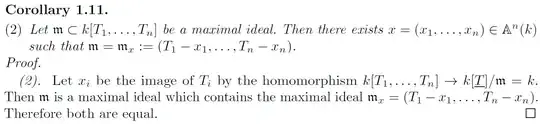
Our lemma says that $\frm_x=I(\{x\})$, for $x\in\bbA_k^n$. Hence, for $Z\subset\bbA_k^n$, we have

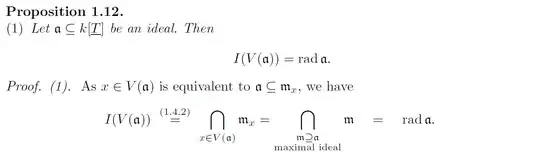 In the middle equality we've used Corollary 1.11(2). The last equality is the fact that $k[T_1,\dots,T_n]$ is Jacobson. $\square$
References
[GW] U. Görtz, T. Wedhorn, Algebraic Geometry I: Schemes. Second ed. Springer Spektrum.


