12

I am trying to understand this comic:
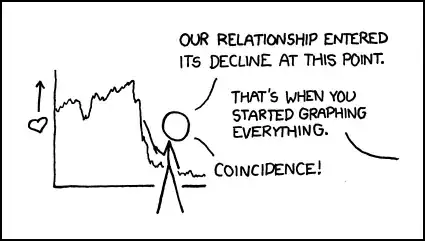
https://imgs.xkcd.com/comics/decline.png

Note that after hovering over the image more text is revealed namely,

"...spike in the Fourier Transform at the one month mark where...".

Is the joke referring to an implied jump discontinuity where perhaps this 'couple' has an argument i.e. no single limit because the one sided limits were finite but not equal? Any clarity on this comic would be appreciated. Thank you.

  • 8
    https://www.explainxkcd.com/wiki/index.php/523:_Decline – Nigel Overmars Aug 12 '16 at 16:44
  • 10
    A high value of the Fourier transform at frequency $f$ indicates a cyclic nature to the relationship at that frequency. So presumably, it is a joke about menstrual cycles and the effects on the relationship - there is a strong "monthly" signal in the happiness of the relationship. – Thomas Andrews Aug 12 '16 at 16:45
  • 7
    Note that the "Explain XKCD" gets a part of it wrong. The spike in the Fourier coefficient does not necessarily mean a monthly event, but rather, a monthly ebb and flow. Err, so to speak. – Thomas Andrews Aug 12 '16 at 16:53
  • touché T. Andrews – Natalie Lauf Aug 12 '16 at 16:56
  • 1
    @ThomasAndrews: I want to upvote and flag that comment all at once. :-P – Brian Tung Sep 06 '16 at 23:25

2 Answers2

10

I think it's about mathematicians over-analysing everything in complex logical terms when there might be some common-sense explanation. But it's a double-joke because doing maths is inherently antisocial and he's trying to fix his relationship by doing maths.

  • 9
    This explains the joke in the drawing, but I think it misses the Fourier transform joke in the hover text. And doing maths can be quite a social activity, in fact. – Sasho Nikolov Aug 12 '16 at 20:32
  • 7
    How has this been upvoted 10 times and marked correct when it doesn't answer the OP's question? – user121330 Aug 12 '16 at 21:58
  • @user121330 as a mathematician you have to remember you're the guy in the drawing with your graph and your Fourier analysis of your partner's behaviour, resolute in your understanding of the situation and seemingly oblivious to the obvious fact that in the real world she doesn't care whatsoever what the maths says. I think there's also a part of the joke that's about the paradox of the assymetric understand between a mathematician and a non-mathematician. But that's both the extra stuff the mathematician knows and the fact he can't see the wood for the trees. – it's a hire car baby Aug 13 '16 at 07:26
  • @user121330 Thank you for your input. Invaluable. – Natalie Lauf Aug 13 '16 at 11:27
  • @robertfrost I recommend reading the entire alt-text, not just the quoted part, before asserting the off-comic person doesn't care. The asymmetric understanding part of the joke, which you answered quite well, belongs on another stack. Thomas Andrews' comment (and obviously explainxkcd) addresses the part of the joke that belongs here. – user121330 Aug 14 '16 at 21:02
  • @user121330 I already read it all and I disagree – it's a hire car baby Aug 14 '16 at 21:42
  • 1
    @Robertfrost "You want to stop talking right now." – user121330 Aug 15 '16 at 06:04
  • As I said, you should stick to poetry. – Mikhail Katz Nov 08 '17 at 16:09
2

I was surfing in the site, reading past articles, and found this one.

For me, the comic represents Goodhart's law:

https://en.wikipedia.org/wiki/Goodhart%27s_law

  • 1
    It really doesn't. There is no indication that the character is using it as a "target" or placing pressure "upon it for control purposes". Also, the failure mode that leads to Goodhart's law is gaming the measure. This doesn't produce a drop in the measured result, instead it decouples the measure from the actual thing we care about for which the measure was only a surrogate. This separation between the thing measured and the thing we actually care about is also not evident in the comic. A Goodhart's law comic in this vein would involve something like algorithmically generated love letters. – Derek Elkins left SE Mar 09 '18 at 12:54