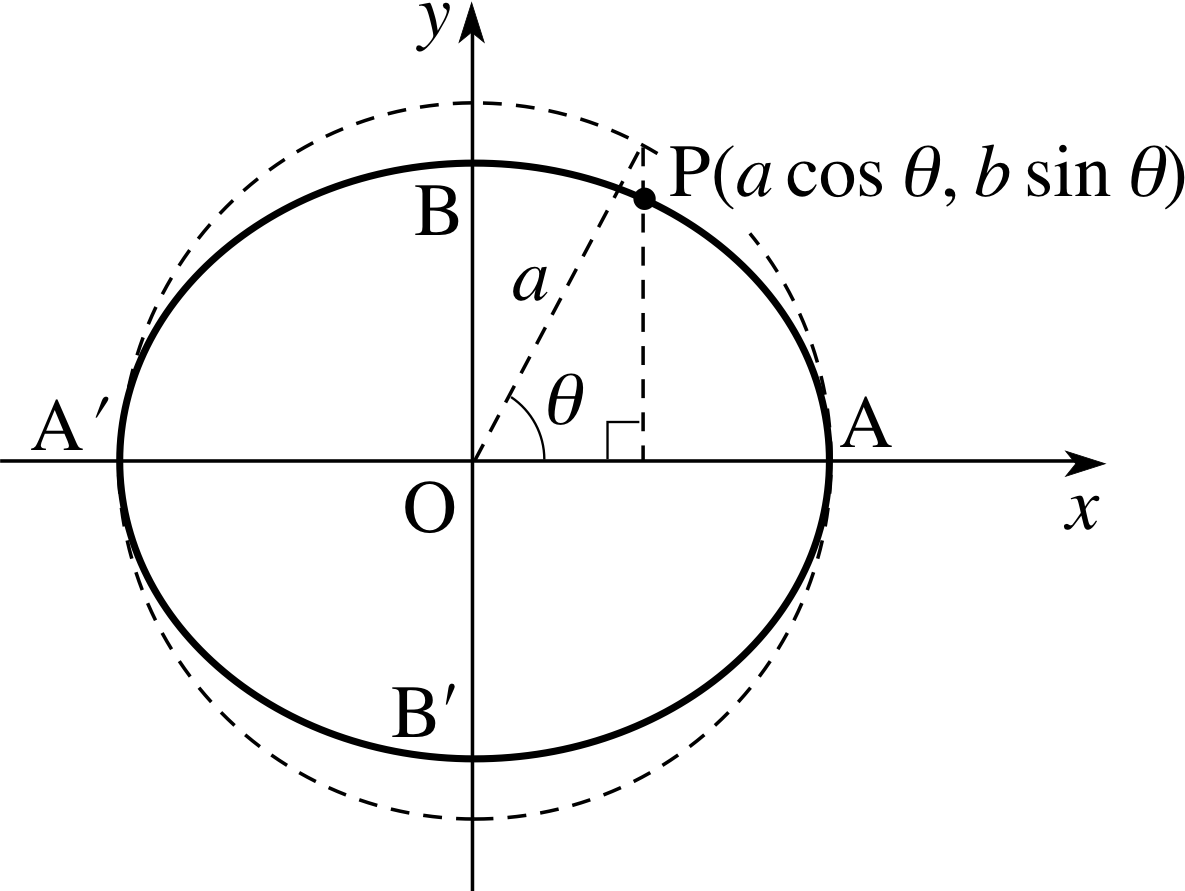
I will make a guess that the graphics program renders an ellipse by stretching or shrinking a circle by different amounts in the horizontal and vertical directions, and that the angles that determine the start and end of each arc are measured on the circle before it is stretched/shrunk.
That is, the direct input to the graphics function uses angles like the angle
named $\theta$ in Figure 14 on
this page
to decide where to start or stop an arc.
I also assume that the green arc represents an arc from $0$ degrees (at the right end) to $180$ degrees (at the left end),
and that the horizontal coordinates of points are increasing as we go to the right.
Let the horizontal radius of the ellipse be $a$ and let the center of the ellipse have horizontal coordinate $x_C.$
For a vertical line at horizontal coordinate $x_1,$ let
$$
\theta = \arccos\left(\frac{x_1 - x_C}{a} \right),
$$
where $\arccos(\cdot)$ is the inverse cosine function.
Then $\theta$ is the angle that the graphics function takes to describe the point where the vertical line meets the ellipse.
Note that in many (if not all) math libraries that have an inverse cosine function, the output of the function is in radians rather than degrees. If you really need degrees for your graphics input, you may need to multiply by $\frac{180}{\pi} \approx 57.2957795131.$
In case you do not have an inverse cosine function,
there are workarounds that use either the inverse tangent function
or inverse sine function, but this problem becomes a lot more difficult
if you have no access to any inverse trigonometric functions.