1

I sketched the function $f(x) = x^{6/7}-9x^{2/7}$ and got something like this.
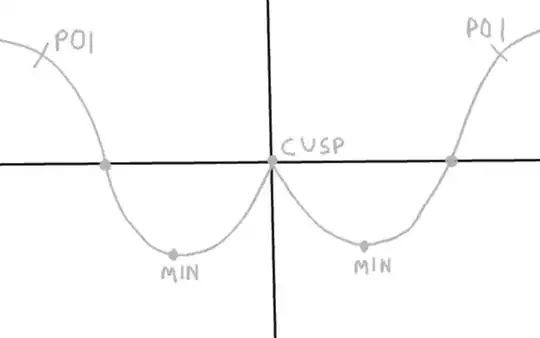
Where POI means point of inflection.

However, when I graph it in Desmos, I get what looks like an oblique asymptote, that corresponds to an absolute value function.
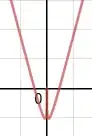
The more I zoom out though, the more the slope seems to decrease.
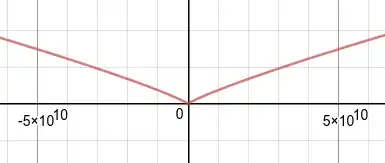
This shows (or at least lends credence) to the fact that there are two POIs, right? In addition, is it true that there is no asymptote?

This is my solution.

Jack Pan
  • 1,704
  • How did you find the locations of the minima and the inflexions? – zoli Mar 14 '17 at 21:41
  • I took the first derivative, and wrote down whether f'(x) was positive or negative in a given interval on a number line. That determined the local extrema. I did the same with f''(x) to find the concavity. This is my solution. http://imgur.com/ljJdtiS – Jack Pan Mar 14 '17 at 21:50
  • 1
    There is nothing wrong with your solution. Your Desmos graph is wrong. Here is the correct Desmos graph: https://www.desmos.com/calculator/fglop1ux1x Or perhaps the scale on your Desmos graph is just inappropriate? – John Wayland Bales Mar 14 '17 at 22:07
  • 1
    @MaxLi: Yes, your solution is OK. – zoli Mar 14 '17 at 22:13
  • @JohnWaylandBales Hi, I tried all kinds of scales and there always seemed to be an oblique asympotote, despite there being two POIs. Is that just a peculiarity of the graph, a kind of "don't trust your eyes, trust the math" kind of thing? – Jack Pan Mar 14 '17 at 22:14
  • 1
    No, if you keep increasing the scale the slope of the apparent oblique asymptote keeps decreasing. Take $\lim_{x\to\infty}\frac{y}{x}$ and you will see that the limit is $0$. – John Wayland Bales Mar 14 '17 at 22:18

1 Answers1

2

In fact, there is no contradiction concerning your POI, with abscissas at $\pm (15)^{7/4} \approx \pm 114.3$ : it is impossible to spot them even on an large curve plainly because the transition from positive to negative concavity is very faint.

See graphics below obtained with Geogebra. The first one for the variations of function $f$, the second one for function $f''$, the latter graphics evidencing an extremely small variation (order $10^{-5}$), before and after the abscissa the transition at the POI.

Remark: $f''(x)=-\dfrac{6}{49}\dfrac{x^{4/7}-15}{x^{12/7}}.$

enter image description here

$$\text{Above: Curve of f}.$$

enter image description here

$$\text{Above: Curve of} \ f'' \ \text{ in the vicinity of a POI}.$$

Jean Marie
  • 81,803
  • What is the reason for the transition between concavities being so faint? – Jack Pan Mar 14 '17 at 22:34
  • If you study the variations of $f''$ : its curve remains extremely close to the $x$ axis in a large region around (+115 ; 0). I am going to give a plot of it, its amazing. – Jean Marie Mar 14 '17 at 22:52
  • https://i.snag.gy/aZeCy3.jpg Why is there a third x-intercept for $f''$? – Jack Pan Mar 14 '17 at 22:56
  • 1
  • I have added the curve of $f''$ in my answer. 2) Why do you believe there is a supplementary intercept at this point ? It is impossible: equation $x^{4/7}-15=0$ has a unique real positive root.
  • – Jean Marie Mar 14 '17 at 23:29
  • It must be a bug in desmos. Thank you! – Jack Pan Mar 15 '17 at 00:02