2

Please Help me to fill in the gaps

Show

$$ \frac{\text d \langle {p} \rangle}{ \text{d} t} =\left\langle - \frac{ \partial V }{\partial x} \right\rangle .$$


$$\frac{\text d \langle {p} \rangle}{ \text{d} t} $$ $$= \frac{\text d}{\text d t} \int\limits_{-\infty}^{\infty} \Psi^* \left( \frac{\hbar}{i}\frac{\partial}{\partial x} \right) \Psi ~\text d x$$ $$= \frac{\hbar}{i}\int\frac{\partial }{\partial t} \left(\Psi^*\frac{\partial\Psi}{\partial x}\right)~\text d x $$ $$= \frac{\hbar}{i}\int \frac{\partial \Psi^*}{\partial t}\frac{\partial \Psi}{\partial x} +\Psi^*\frac{\partial }{\partial x}\frac{\partial \Psi }{ \partial t} ~\text {d} x$$ $$= \frac{\hbar}{i}\int\left( -\frac{i\hbar}{2m}\frac{\partial^2 \Psi^*}{\partial x^2}+\frac{i}{\hbar} V\Psi^*\right)\frac{\partial \Psi}{\partial x}+\Psi^* \frac{\partial}{\partial x} \left(\frac{i\hbar}{2m} \frac{\partial^2 \Psi }{\partial x^2} -\frac{i}{\hbar}V\Psi \right)~\text d x$$ $$=\int\left(V\Psi^*-\frac{\hbar^2}{2m}\frac{\partial^2 \Psi^*}{\partial x^2}\right) \frac{\partial \Psi}{\partial x}+\Psi^*\frac{\partial}{\partial x}\left(\frac{\hbar^2}{2m}\frac{\partial^2 \Psi}{\partial x^2}-V\Psi\right)\text d x$$

$$=\left. \left(V\Psi^*-\frac{\hbar^2}{2m}\frac{\partial^2 \Psi^*}{ \partial x^2} \right) \Psi \right|_{-\infty}^{\infty}-\int\left(\frac{\partial}{\partial x} (V\Psi^*)-\frac{\hbar^2}{2m}\frac{\partial^3 \Psi^*}{ \partial x^3}\right)\Psi \text d x+ \qquad\qquad\left.\Psi^*\left(\frac{\hbar^2}{2m}\frac{\partial^2 \Psi}{\partial x^2} - V\Psi\right)\right|_{-\infty}^\infty-\int\frac{\partial\Psi^*}{\partial x} \left( \frac{\hbar^2}{2m}\frac{\partial ^2 \Psi}{\partial x^2} - V \Psi \right)\text d x$$

$$=0 + \int\left(\frac{\hbar^2}{2m}\frac{\partial^3 \Psi^*}{ \partial x^3}-\frac{\partial}{\partial x} (V\Psi^*)\right) \Psi \text d x+0+\int\frac{\partial\Psi^*}{\partial x}\left(V\Psi - \frac{\hbar^2}{2m}\frac{\partial^2 \Psi}{\partial x^2}\right) \text d x$$ $$=\int\frac{\hbar^2}{2m} \left(\frac{\partial^3\Psi^*}{\partial x^3}\Psi -\frac{\partial\Psi^*}{\partial x} \frac{\partial^2\Psi}{\partial x^2}\right)+\frac{\partial\Psi^*}{\partial x}(V\Psi )-\frac{\partial}{\partial x}(V\Psi^*)\Psi\text d x $$

$$\vdots$$ $$=\int \frac{\hbar^2}{2m}\left( \Psi^* \frac{\partial^3 \Psi}{\partial x^3} -\frac {\partial^2 \Psi^*}{\partial x^2} \frac{\partial \Psi}{\partial x} \right)+\left( V \Psi^* \frac{\partial \Psi}{\partial x}-\Psi^* \frac{\partial}{\partial x} (V \Psi) \right)~\text d x$$ $$\vdots $$ $$= \int \left( V \Psi^* \frac{\partial \Psi}{\partial x}-\Psi^*V \frac{\partial \Psi}{\partial x} - \Psi^* \frac{\partial V}{\partial x} \Psi \right)~\text d x$$ $$= \int\limits_{-\infty}^{\infty} -\Psi^* \frac{\partial V}{\partial x} \Psi ~\text {d} x$$ $$=\left\langle - \frac{ \partial V }{\partial x} \right\rangle $$


Edit:

Problem 1.7 (Introduction to Quantum Mechanics, 2edJ -David G. Griffiths)

Calculate $ \frac{\text d \langle {p} \rangle}{ \text{d} t}$

The solutions manual for the text provides this incomplete method, I haven't worked out all the details
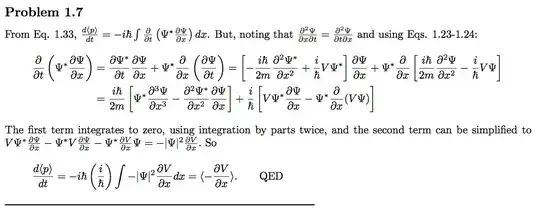
solution in solutions manuel

3 Answers3

1

You're effectively applying the Ehrenfest theorem (see the section "General example"), but you're not making use of the fact that the momentum operator commutes with the kinetic energy (which is essentially just the square of the momentum operator). The two terms involving the kinetic energy are complex conjugates of each other, and thus, since they're real, they cancel. The same for the two terms involving the potential energy that involve the derivative of the wave function and not of the potential.

joriki
  • 238,052
  • 1
    you have completely dodged the question – Elements In Space Dec 27 '12 at 02:37
  • @Unkle: Could you please elaborate on that comment? – joriki Dec 27 '12 at 12:08
  • joriki, I'm not sure how to apply what you or Fabian have said to my eighth line. – Elements In Space Dec 27 '12 at 12:41
  • @Unkle: It's extremely bad style to change the question without marking the edit, and then write under an existing answer that it dodged the question, making it look like it dodged the edited version of the question. That doesn't make me feel inclined to spend any more of my time on your question. Good luck. – joriki Dec 27 '12 at 13:07
  • Well, I am new to this space. I don't think that the style of the question has been changed much, as I originally asked 'Please Help me to fill in the gaps', and that's still what I am looking for... I didn't mean to put you offside, pax. – Elements In Space Dec 27 '12 at 13:22
  • I have edited the edit into the question now. I hope this is what joriki ment. – Elements In Space Dec 28 '12 at 04:27
1

Just two expand on joriki's answer. Your statement is not true for general Hamiltonian but only for Hamiltonian of the form (kinetic energy which does not depend on position and potential energy which does not depend on time) $$H = T(p) + V(x).$$

Then using the fact that $p = -i \partial_x$ and $\dot p = i [H,p]$, you can show easily that $$ \frac{dp}{dt} = i \underbrace{[T(p), p]}_{=0} + i [V(x), p] = - V'(x). $$ So you equation is even valid before taking the expectation value.

Fabian
  • 23,360
  • 1
    Note for beginning students of QM: this is in the Heisenberg picture, rather than the Schrödinger one. – Stan Liou Nov 03 '12 at 09:14
0

Starting with $$ \left( -\frac{i\hbar}{2m}\frac{\partial^2 \Psi^*}{\partial x^2}+\frac{i}{\hbar} V\Psi^*\right)\frac{\partial \Psi}{\partial x}+\Psi^* \frac{\partial}{\partial x} \left(\frac{i\hbar}{2m} \frac{\partial^2 \Psi }{\partial x^2} -\frac{i}{\hbar}V\Psi \right) $$

Collecting terms & applying the constant, we have
$$ i\hbar \left(\frac{i\hbar }{2m}\left( \Psi ^{*}\frac{\partial ^{3} \Psi }{\partial x^{3}} -\frac{\partial ^{2} \Psi ^{*}}{\partial x^{2}}\frac{\partial \Psi }{\partial x}\right) +\frac{i}{\hbar }\left( V\Psi ^{*}\frac{\partial \Psi }{\partial x} -\Psi ^{*}\frac{\partial }{\partial x}( V\Psi )\right)\right) $$

The right hand expression conveniently (apply constants & product rule) reduces to
$$ V\Psi ^{*}\frac{\partial \Psi }{\partial x} -\Psi ^{*} V\frac{\partial \Psi }{\partial x} -\Psi ^{*}\frac{\partial V}{\partial x} \Psi $$ where we see the result we seek. Remember...this is under the integral. We just ignored the integral to simplify the work.

However, that leaves the pesky left hand expression, which is where many students seem to stumble, and it seems that is the question that the OP asks...not the actual physics intended, which we observe from the result, but how the devil to get there...in this case, that means getting rid of that first expression.

Ignoring the constant, we can pull a partial x out to give us $$ \frac{\partial }{\partial x}\left( \Psi ^{*}\frac{\partial ^{2} \Psi }{\partial x^{2}} -\frac{\partial \Psi ^{*}}{\partial x}\frac{\partial \Psi }{\partial x}\right) $$ Integrating this expression by x, and recalling that $\Psi$ and its derivatives go to zero as x goes to +- infinity, we see that this expression goes to zero, leaving only the expression with V above.

Griffiths recommends using integration by parts in several places in his text. There is no shortcut there...you must simply go through the steps and see which terms to integrate so that they all cancel in the end. Experience counts here. Instead of pulling the partial of x out of the expression, integrate each term twice by parts to see the effects. One of the combinations will reduce the expression, and the boundary terms will go to zero for the usual reasons.