6

When I am working with my child, I am stuck in this geometry problem.

"We have two different points $M, N$ in the plane. Using only compass to construct the midpoint $I$ of the segment $MN$."

Thank you for all helping and comments.

blindman
  • 3,117

3 Answers3

11

Some Googling revealed the following comments to this answer:

  • I know it is possible, but is there an easy way to divide a segment in half with only a compass? – robjohn♦ May 20 at 3:46
  • I don't know if that's "easy", but here's one method:
    1. Find the point $C$ on the ray from $A$ through $B$ such that $|AC|=2|AB|$ using my previous comment [The relevant part: "To double the distance along a ray, use the construction of a regular hexagon with vertex $A$ and center $B$".]
    2. Intersect the circle with center $C$ through $A$ with the circle with center $A$ through $B$ to find $D_1,D_2$.
    3. The midpoint of $AB$ is the second point of intersection of the two circles with center $D_i$ through $A$. – t.b. May 20 at 9:28
  • Here is a picture of what I have in mind: - t.b. May 20 at 12:38
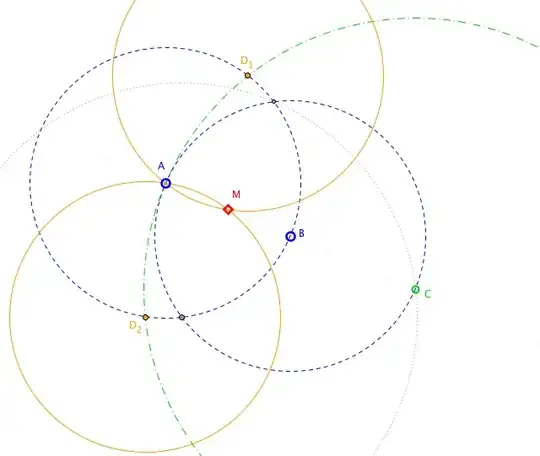
Division in half

The dotted line is not used in the construction.

Added:

The triangles $\Delta ACD_1$ and $\Delta AMD_1$ are isosceles by construction and they share a common angle, hence they are similar. Therefore $AM : AB = AM : AD_1 = AD_1 : AC = AB : AC = 1 : 2$.

commenter
  • 1,666
  • If anyone wants to expand on the details, fell free to do so. – commenter Nov 02 '12 at 04:04
  • 1
    @commenter: Could you give the proof of your construction? Thank you for your construction. – blindman Nov 02 '12 at 04:08
  • @blindman: I added a proof. – commenter Nov 02 '12 at 04:29
  • 1
    The fact that $D_1$ and $D_2$ are symmetric about the line $AB$ means that $M$, being equidistant from both, must be on $AB$. The fact that the triangles $AD_1M$ and $ACD_1$ are both isosceles and share a base angle angle makes them similar. And the ratio of $AC$ to $AD_1$ is 2:1, so the ratio of $AD_1$ to $AM$ is 2:1. Length $AB$ = Length $AD_1$ so $M$ is the midpoint. – Logan Stokols Nov 02 '12 at 04:30
  • @Logan: exactly, thanks! (I added the same argument just a minute ago). – commenter Nov 02 '12 at 04:31
  • @commenter: I see. Thank you very much for your proof. – blindman Nov 02 '12 at 04:34
  • @blindman: you should thank t.b. and robjohn, not me! :-) – commenter Nov 02 '12 at 04:35
0

Open the compass to any length more than half the distance between $\,A,B\,$ but less than their total distance. Put the compass's point on A and trace part of the circle over the line $\,AB\,$ , and after this do the same putting the point on $\,B\,$, (without changing the compass's openning!) and mark the interesection point of the two circles as $\,P\,$.

Now repeat the above with circles under the line segment and mark the intersection point of the two circles as $\,S\,$ (BTW, no need the compass has the very same openning as in the first part!). Since both points $\,P,S\,$ are at the same distance from $\,A\,$ and from $\,B\,$ (why?) , joining them gives you the perpendicular bisector of $\,AB\,$.

Finally, just take the intersection of the Perp. bisector with the segment $\,AB\,$

DonAntonio
  • 211,718
  • 17
  • 136
  • 287
  • 1
    And how do you find the intersection point of the perpendicular bisector with the segment $AB$ without straightedge? – commenter Nov 02 '12 at 03:45
  • As the OP talks of the "segment $,AB,$" I assumed this segment is given, of course. – DonAntonio Nov 02 '12 at 03:46
  • @DonAntonio: Dear Sir. We have to use only compass to construct midpoint. Thank you for your answer. – blindman Nov 02 '12 at 03:46
  • Even if you have the segment $AB$ you still need a straightedge to draw the perpendicular bisector and find the intersection point. – commenter Nov 02 '12 at 03:47
  • So you're not given the segment $,AB,$, @blindman ? Well, then something further must be done...not sure what. – DonAntonio Nov 02 '12 at 03:47
  • @ DonAntonio: Yeah. We only have two different points $M,N$ and we have to find the point $I$ such that $IM=IN$ only by compass. – blindman Nov 02 '12 at 03:51
  • 1
    @DonAntonio: This problem is not easy as we think. – blindman Nov 02 '12 at 03:55
  • No @blindman , not "the point I s.t. $,IM = IN,$ , as there are infinite such points (all the perpendicular bisector, of course). The point $,I,$ also must be on the straight line $,MN,$ , or what is the same: $,\angle MIN=180^\circ,$ – DonAntonio Nov 02 '12 at 04:05
  • @DonAntonio: Yeah. $I,M,N$ are on the same line. Thank you. – blindman Nov 02 '12 at 04:07
0

Finally, by google we find the solution on thess sites: http://gogeometry.com/circle/mascheroni_compass_1.htm http://mathafou.free.fr/themes_en/compas.html

and useful lecture on this problem http://www.math.ualberta.ca/~tlewis/343_10/04sec.pdf

blindman
  • 3,117