if $g(2) = 4$ and $g(3) = 5$, then $\int_2^3 (g'(x) - 1) dx$. i have solve this to be 0 since the anti-derivative of g'(x) - 1 is g(x) - x, therefore, $[g(x) - x]_2^3$ = 0. but how can the area between x = 2 and x = 3 for (g'(x) -1) be 0?
Asked
Active
Viewed 87 times
2

-
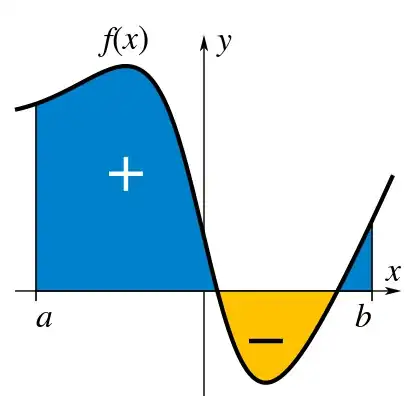
Hint: Notice that an integral is defined to be the area relative to the x-axis, so parts ABOVE the x-axis have POSITIVE area, and parts BELOW the x-axis have NEGATIVE area. What does this tell you about the positive and negative areas? – Toby Mak Jun 03 '17 at 01:09
-
1You solved this integral? I remember an identical integral question hours ago that has been deleted. – peterwhy Jun 03 '17 at 01:12
3 Answers
1
The function $g'(x)-1$ assumes negative and positive values in $[2,3]$, in a way that the sum of the "positive area" and the "negative area" is zero.
It may be clearer if we see that $g'(x)-1$ will be $0$ in a point of the interval: since $g(x)$ goes from 4 to 5 in $[2,3]$, if it is continuous, $g'(x)$ will be equals 1 in some point of the interval (Mean Value Theorem).
The trivial case would be if $g(x)$ is a straight line between the points $(2,4)$ and $(3,5)$: the function $g'(x)-1$ would be $0$ everywhere (and so its integral).

Daniel Cunha
- 1,735
1
This comes from FTC which states that if $F $ is differentiable at $[a,b] $ and $F'$ integrable at $[a,b] $ then $$\int_a^b F'(x )dx=F (b)-F (a) $$ thus if $F (a)=F (b) $, the integral is zero.
in that case, $F$ is not monotonic and $F'$ could take negative and positive values .
for example $$\int_0^{2\pi}\sin (x)dx=0$$

hamam_Abdallah
- 62,951
0
Look at the definition of an integral as a limit of Riemann sums:
$$ \int f = \lim_{\Delta x \to 0} \sum_{i = 1}^n f(x_i^*) \Delta x. $$
Here $f(x_i^*) \Delta x$ is the area of a rectangle with height $f(x_i^*)$ and width $\Delta x$. But note: if $f(x_i^*) < 0$ then the rectangle has negative area by this formula. This turns out to be the most useful definition of integral because we can calculate the area without the negatives by integrating the absolute value of $f$ instead. On the other hand, if we want to account for negative areas (this occurs for example when looking at displacement as an integral of velocity) then this definition is the correct one.
Here's the picture found on Wikipedia:

Trevor Gunn
- 27,041