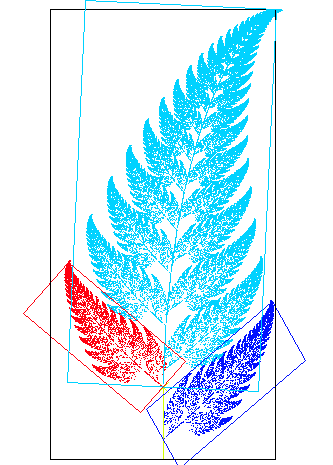
When studying fractals, one of the properties named by Benoit Mandelbrot is the self-similarity (and it's variations) of the fractal objects.
From Wikipedia:
In mathematics, a self-similar object is exactly or approximately similar to a part of itself (i.e. the whole has the same shape as one or more of the parts). Many objects in the real world, such as coastlines, are statistically self-similar: parts of them show the same statistical properties at many scales.[2] Self-similarity is a typical property of artificial fractals.
This can be easily seen in pictures: https://upload.wikimedia.org/wikipedia/commons/4/4b/Fractal_fern_explained.png https://en.wikipedia.org/wiki/Fractal
My question is, is there any way to demonstrate this property in a 'pure mathematical way' ? I know Mandelbrot's purpose was exactly the opposite, to link and demonstrate all this theories in a visual way, but I think any kind of pure demonstration would be great to understand this objects. I haven't been able to find any research about this so I don't know where I could start.