5

Here is a proof of integration by parts: http://www.math.ufl.edu/~mathguy/year/S10/int_by_parts.pdf

But I don't understand how it works. Specifically, I don't understand why $\int_r^s u \, dv$ equals one of the areas (and likewise for $\int_p^q v \, du$).

To me it looks like this only works if $g$ is the inverse of $f$...

Thanks!

dever
  • 59
  • 1
  • 2
  • I share your opinion. To me this picture looks more like a proof of Young's inequality(http://en.wikipedia.org/wiki/Young's_inequality) – Dominik Dec 09 '12 at 01:08

5 Answers5

11

The important part is that the axes themselves are the original $x,y$ axes after applying the functions $u$ and $v$ to them!

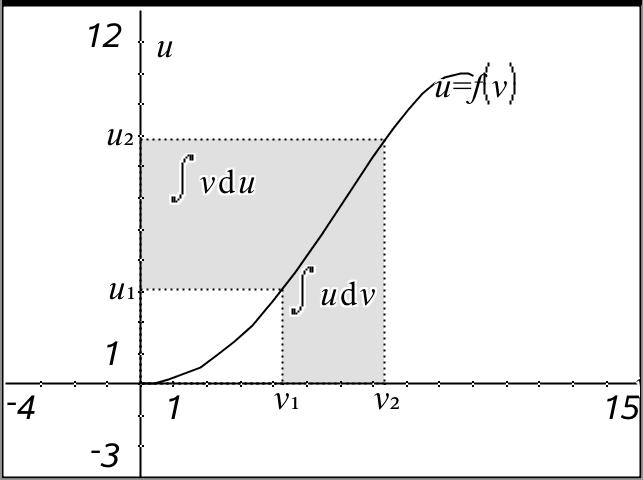
Perhaps this diagram from here is clearer. Because $u=f(v)$ is the height of the curve from the $v$ axis, the area of the bottom part is $\displaystyle \int_{v_1}^{v_2}u \space d v$. But note that $u_1=f(v_1),u_2=f(v_2)$.

Next, let the $v$ values change. Now $v$ is the height of the curve from the $u$ axis, the area of the top part is $\displaystyle \int_{u_1}^{u_2}v \space d u$.

The sum of these areas is a nice difference of areas of boxes. I.e. $u_2v_2-u_1v_1$. This is however the $uv|_{(v_1,u_1)}^{(v_2,u_2)}$. So, symbolically

$\displaystyle \int_{v_1}^{v_2}u \space d v +\int_{u_1}^{u_2}v \space d u=uv|_{(v_1,u_1)}^{(v_2,u_2)}$.

Arkady
  • 9,315
  • I think you're onto it here. Am I going the wrong direction with the bottom half of my answer, or is it in agreement with yours? – 000 Dec 08 '12 at 23:51
  • I think we agree. Except, you probably meant to name the map that you define in the second paragraph of your second section as $f$ and not $v$. This way, as Hagen von Eitzen describes below, $f$ is the curve parametrizing $u$ and $v$ as a function of $t$ varying between the original bounds of integration $a$ and $b$ – Arkady Dec 09 '12 at 00:09
  • 1
    I removed the original variables in the situation and restructured it in terms of axis $u$ and axis $v(u)$. Thus, I think, my work also coincides with Hagen von Eitzen since I've said $u=f(x_0)$ for some $x_0$ and $v(u)=g(x_1)$ for some $x_1$. It may be easier to say $(u,v(u))=(f(t),g(t))$, though. – 000 Dec 09 '12 at 00:16
  • What does the pipe symbol in $uv|_{(v_1,u_1)}^{(v_2,u_2)}$ represent? – James Ko Jan 21 '17 at 03:34
3

If we play around with the graph in our head, we can look at it from two perspectives: $(U,V(U))$ and $(V,U(V))$. That is, if we look at it from how it is presented, we see that the area of the second box in the equation is $\int_{p}^{q}V(U)dU.$ In their notation, that's exactly $\int_{p}^{q}vdu$. This follows from the definition of a definite integral.

Now, if we flip the graph (turn your head sideways), reflect it to the left, and look at it from the perspective of $(V,U(V))$, we see that the area underneath the flipped curve is $\int_{r}^{s}U(V)dV$. This is, in their notation, $\int_{r}^{s}udv$.

This is why we have that the total sum of the areas is $\int_{r}^{s}udv+\int_{p}^{q}vdu.$


There is not a loss of rigor what so ever in this diagram. It is quite unsettling at first, but what we're really just doing is this:

Let $v: U \to V$ be a map where, for a $u \in U$, we have $u \mapsto v(u)$. The domain and range thus form the set of ordered pairs $\{(u,v(u)): u\in U\}$. Our other map, $v^{-1}:V \to U$, is the flip-then-reflect-left map with the mapping $v(u) \mapsto u$. It is the set of ordered pairs $\{(v(u),u): u\in U\}$. This is the inverse map of $v$ by definition.

Having that $u=f(x_0)$ for some $x_0$ and $v(u)=g(x_1)$ for some $x_1$, however, does not necessarily imply $g$ is the inverse of $f$.

000
  • 5,760
2

The black curve should be viewed as parametric curve $(f(t),g(t))$, $a\le t\le b$.

0

The area between the curves and the axes adds together to give the area of the rectangle with area $qs$, with the square of area $pr$. So subtract the two areas and set them equal to the sum of the integrals. Thank you for this proof, I really like it!

0

He used the formula that the area of a region under the curve $y=g(x),x=v(x)$ is equal to $\int_{C} xdy=\int_{C}vdu$. This is from Green's formula. See this wikipedia article. Since the derivation of Green's formula does not involve integration by parts, this is a "proof without words".

Bombyx mori
  • 19,638
  • 6
  • 52
  • 112