0

You are given:

(i) $X$ is the current value at time 2 of a 20-year annuity-due of 1 per annum.

(ii) The annual effective interest rate for year $t$ is $\dfrac{1}{8+t}$.

Find $X$

Here is what I did, since $X$ is the current value at time 2, (denote PV-present value)

$X = PV(t=0)(1+i_i)(1+i_2)$

Hence I need to find the $PV(t=0)$ first. But finding the $PV$ is a bit of a task, and I don't know if I'm going in the right direction. Since we have an annuity-due

$PV(t=0) = 1 + (1+i_1)^{-1} + (1+i_1)^{-1}(1+i_2)^{-1}+\cdot\cdot\cdot+(1+i_1)^{-1}\cdot\cdot\cdot(1+i_9)$

$= 1+(1+\dfrac{1}{9})^{-1}+(1+\dfrac{1}{9})^{-1}(1+\dfrac{1}{10})^{-1}+\cdot\cdot\cdot+(1+\dfrac{1}{9})^{-1}\cdot\cdot\cdot(1+\dfrac{1}{17})^{-1}$

Is this right?

  • See here: http://www.actuarialoutpost.com/actuarial_discussion_forum/showthread.php?t=265739 –  Dec 28 '17 at 15:16
  • 1
    At year 2, you will have $1+(1+i_2)+(1+i_1)(1+i_2)$ amount of money from the cashflows prior to (and including) $t=2$. But you will also have some of values added by discounting future cashflows to get their present value, which looks a bit like your $PV(t=0)$, but starting with $1+(1+i_2)^{-1}$ etc – user160738 Dec 28 '17 at 15:30

2 Answers2

2

Let be $i_t=\frac{1}{8+t}$.

Annuity due

The current value $X$ a time $t=2$ (in case of annuity due) is the sum of the present value $X_{>2}$ of the stream after $t=2$, the future value of the stream $X_{<2}$ before $t=2$ and the value $X_{2}$ at $t=2$, that is $$X=X_{<2}+X_{2}+X_{>2}$$ enter image description here
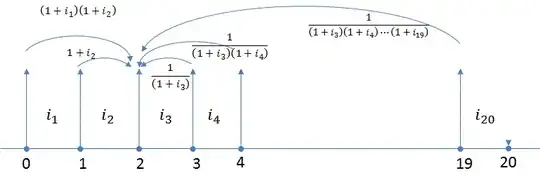
$$ \begin{align*} X_{>2}&=\sum_{k=3}^{19}\frac{1}{\prod_{t=3}^k\left(1+i_t\right)}=\tfrac{1}{(1+i_3)}+\tfrac{1}{(1+i_3)(1+i_4)}+\cdots+\tfrac{1}{(1+i_3)(1+i_4)\cdots(1+i_{19})}\\ &=\frac{1}{\frac{{9+3}}{8+3}}+\frac{1}{\frac{\color{red}{9+3}}{8+3}\frac{9+4}{\color{red}{8+4}}}+\cdots+\frac{1}{\frac{\color{red}{9+3}}{8+3}\frac{9+4}{\color{red}{8+4}}\cdots\frac{\color{red}{9+18}}{8+18}\frac{9+19}{\color{red}{8+19}}}\\ &=\frac{1}{\frac{9+3}{8+3}}+\frac{1}{\frac{9+4}{8+3}}+\cdots+\frac{1}{\frac{9+19}{8+3}}\\ &=(8+3)\sum_{k=3}^{19}\frac{1}{9+k}\\ X_{>2}&\approx 9.98\\ X_{2}&=1\\ X_{<2}&=(1+i_1)(1+i_2)+(1+i_2)=(2+i_1)(1+i_2)=\left(2+\frac19\right)\left(1+\frac{1}{10}\right)=2.32 \end{align*}$$ and then

$$ X=X_{<2}+X_{2}+X_{>2}\approx 13.3 $$

Annuity immediate

The current value $X$ a time $t=2$ (in case of annuity immediate) is the sum of the present value $X_{>2}$ of the stream after $t=2$, the future value of the stream $X_{<2}$ before $t=2$ and the value $X_{2}$ at $t=2$, that is $$X=X_{<2}+X_{2}+X_{>2}$$ enter image description here
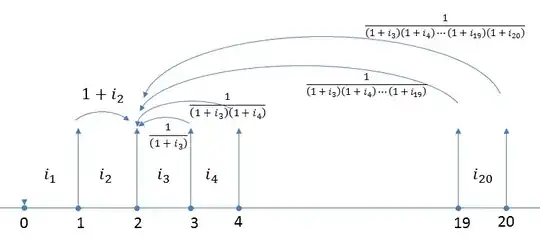
$$ \begin{align*} X_{>2}&=\sum_{k=3}^{20}\frac{1}{\prod_{t=3}^k\left(1+i_t\right)}=\tfrac{1}{(1+i_3)}+\tfrac{1}{(1+i_3)(1+i_4)}+\cdots+\tfrac{1}{(1+i_3)(1+i_4)\cdots(1+i_{20})}\\ &=\frac{1}{\frac{{9+3}}{8+3}}+\frac{1}{\frac{\color{red}{9+3}}{8+3}\frac{9+4}{\color{red}{8+4}}}+\cdots+\frac{1}{\frac{\color{red}{9+3}}{8+3}\frac{9+4}{\color{red}{8+4}}\cdots\frac{\color{red}{9+19}}{8+19}\frac{9+20}{\color{red}{8+20}}}\\ &=\frac{1}{\frac{9+3}{8+3}}+\frac{1}{\frac{9+4}{8+3}}+\cdots+\frac{1}{\frac{9+20}{8+3}}\\ &=(8+3)\sum_{k=3}^{20}\frac{1}{9+k}\\ X_{>2}&\approx 10.36\\ X_{2}&=1\\ X_{<2}&=(1+i_2)=1+\frac{1}{10}=1.1 \end{align*}$$ and then

$$ X=X_{<2}+X_{2}+X_{>2}\approx 12.46 $$

alexjo
  • 14,976
-2

You can ignore the past other than to set the parameters. $X$ is just the PV of the remaining 18 annuity payments. Thus

$X=1+(1+\frac{1}{11})^{-1} + (1+\frac{1}{11})^{-1}(1+\frac{1}{12})^{-1} + \cdots +(1+\frac{1}{11})^{-1}(1+\frac{1}{12})^{-1}\cdots(1+\frac{1}{27})^{-1}$

This can be simplified.

EDIT: I blew it, but leaving my mistake up because that's how we learn.
As @alexjo shows I forgot the definition of current value.
I need to add in $X_{<2}$, the accumulated value of prior payments.
But I think alexjo erred in the value of:
$\begin {align} X_{<2} &= (1+\frac{1}{9})(1+\frac{1}{10})+(1+\frac{1}{10})\\ \text {adding it to my original answer we get:}\\ \text {corrected } X &= X_{<2} + \text { original }X\\ &=11\bigl(\frac {1}{9}+\frac {1}{10}+\frac {1}{11} + \cdots + \frac {1}{28}\bigr) \end {align}$

Stephen Meskin
  • 1,829
  • 8
  • 17