2

this is set of equations I am working on the following equations:

D(t)=D(t-1)+(1-P(t-1)/P'*alpha)
P(t)=P(t-1)-(1-D(t-1)/D'*beta)+(1-R(t-1)/R'*gamma)
R(t)=R(t-1)+(1-D(t-1)/D'*eta)

where D is demand, P; Price, R;Resources and D',P',R' are the constants of can say maximums of respective and alpha beta are conversion ratios. what I an trying is to solve this set of equations but the resultant graph I get goes in negative values. the values I selected for initial condition are the graph is a diverging graph and the values are D(o)=5;P(o)=5;R(o)=5; ratios are all 1. and maximum values are all 10 but the graph diverges to large values in both positive and negative sizes? Is it possible that these values move around the maximums? I cant show thee graph because I am beginner on this site.

Summyia
  • 33
  • Are there valid ranges of $P'$, $D'$, $R'$, $\alpha$, $\beta$, $\gamma$, and $\eta$, or can these literally be any complex numbers at all? – Eric Towers Mar 23 '18 at 22:19
  • they cannot be complex numbers P'D'R' should be >0 and rest can be real numbers. but I tool them 1 for simplicity. – Summyia Mar 23 '18 at 22:26
  • When you write "(1-P(t-1)/P'*alpha)", do you mean $(1 - \frac{P(t-1)}{P'}\alpha)$, which is what that code means (in many programming languages)? – Eric Towers Mar 24 '18 at 07:56
  • this is basically (1-P(t-1)/P') one term multiplied by alpha – Summyia Mar 24 '18 at 20:33
  • why it is so that the graph goes in negative? my initial values are positive and I want them to remain positive..Is there any mistake in equations?or signs of equations? – Summyia Mar 24 '18 at 20:35

2 Answers2

2

With the particular values you have chosen, you are using the system of equations \begin{align*} D(t) &= D(t-1) + \left( 1 - \frac{P(t-1)}{10} \cdot 1 \right) \\ P(t) &= P(t-1) - \left( 1 - \frac{D(t-1)}{10} \cdot 1 \right) + \left( 1 - \frac{R(t-1)}{10} \cdot 1 \right) \\ R(t) &= R(t-1) + \left( 1 - \frac{D(t-1)}{10} \cdot 1 \right) \end{align*}

With this system, $D(43) = -0.55672\dots$ is the first negative.
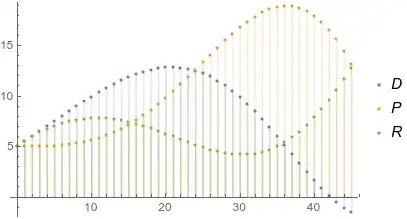
Mathematica graphics

How does this happen? Once demand exceeds 100%, resources decrease and price begins to rise precipitously. Eventually price is high enough to inhibit demand and demand decreases. However, at this point, the price is so high, demand is still in excess of 100%, and resources are somewhat depleted, so the price continues to rise for some time, producing a large positive overshoot. During this large overshoot, demand plummets to be negative.

Why does this happen? There is nothing to prevent demand exceeding 100%. In particular, $D(11) = 10.3375\dots$. Nor does anything else about this system prevent any of $D$, $P$, or $R$ exceeding $10$ or becoming negative.

We can write your system as $$ \begin{pmatrix} D(t) \\ P(t) \\ R(t) \\ 1 \end{pmatrix} = \begin{pmatrix} 1 & \frac{-1}{10} & 0 & 1 \\ \frac{1}{10} & 1 & \frac{-1}{10} & 0 \\ \frac{-1}{10} & 0 & 1 & 1 \\ 0 & 0 & 0 & 1 \end{pmatrix} \cdot \begin{pmatrix} D(t-1) \\ P(t-1) \\ R(t-1) \\ 1 \end{pmatrix} $$ We can jump along by as many steps as we like by multiplying by powers of this square matrix. However, this square matrix has four eigenvalues, with magnitudes parts $1.04\dots$, $1.04 \dots$, $1$, and $0.93\dots$. Consequently, some of the entries in the successive powers of this matrix will grow without bound. In other words, this system is unstable. (The two eigenvalues with magnitudes greater than $1$ are a complex conjugate pair, so we should expect the system to oscillate with an amplitude envelope growing about 3% per step, which is what happens.)
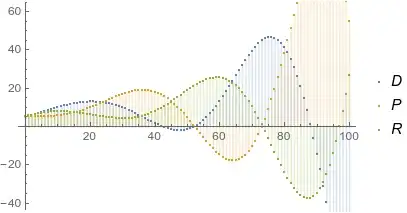
Mathematica graphics

(In more detail, there is a 2-dimensional subspace where solutions grow without bound, a 1-dimensional subspace (spanned by $(0,0,0,1)$ with eigenvalue $1$) where the solutions neither grow nor shrink, and a 1-dimensional subspace where the solutions are stable. Any given initial condition projects onto these three subspaces. If the initial condition has a nonzero projection onto the 2-dimensional subspace, that part of the solution will oscillate with magnitude that increases without bound.)

Let's try placing hard limits of $0$ and $10$ on each of $D$, $P$, and $R$ and see what happens.

\begin{align*} D(t) &= \max\{0, \min\{ 10, D(t-1) + \left( 1 - \frac{P(t-1)}{10} \cdot 1 \right) \}\} \\ P(t) &= \max\{0, \min\{ 10, P(t-1) - \left( 1 - \frac{D(t-1)}{10} \cdot 1 \right) + \left( 1 - \frac{R(t-1)}{10} \cdot 1 \right) \}\} \\ R(t) &= \max\{0, \min\{ 10, R(t-1) + \left( 1 - \frac{D(t-1)}{10} \cdot 1 \right) \}\} \end{align*}

With these hard limits in place, the system stabilises about as quickly as could be expected when the initial changes in $D$ and $R$ are about $+5/10$.
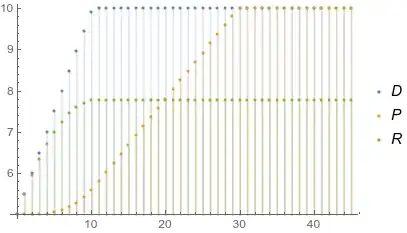
Mathematica graphics

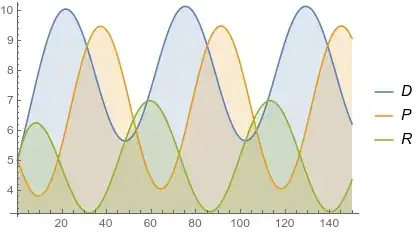
Is there something less draconian we could do? Let's see whether we can make the system stable by altering the diagonal of the square matrix (i.e., reduce the memory in the three functions). We look at this matrix $$\begin{pmatrix} x & \frac{-1}{10} & 0 & 1 \\ \frac{1}{10} & x & \frac{-1}{10} & 0 \\ \frac{-1}{10} & 0 & x & 1 \\ 0 & 0 & 0 & 1 \end{pmatrix} \text{.} $$ Numerically searching for the $x$ that makes the magnitudes of each of the eigenvalues be $1$, we find $x = 0.95911\dots$ should be the boundary between stable and unstable behaviour. If we take $x = 0.9$, the analysis above says the system should be stable. \begin{align*} D(t) &= 0.9 D(t-1) + \left( 1 - \frac{P(t-1)}{10} \cdot 1 \right) \\ P(t) &= 0.9 P(t-1) - \left( 1 - \frac{D(t-1)}{10} \cdot 1 \right) + \left( 1 - \frac{R(t-1)}{10} \cdot 1 \right) \\ R(t) &= 0.9 R(t-1) + \left( 1 - \frac{D(t-1)}{10} \cdot 1 \right) \end{align*}
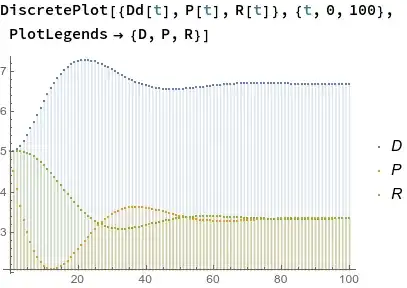
Mathematica graphics

With $x = 0.95911$ (where the eigenvalue magnitudes are $1$, $0.89\dots$, and $0.999995\dots$), we expect a short-lived component of the solution (decaying by about 1-0.89 = 11% per step) and a nearly stable component of the solution. \begin{align*} D(t) &= 0.95911 D(t-1) + \left( 1 - \frac{P(t-1)}{10} \cdot 1 \right) \\ P(t) &= 0.95911 P(t-1) - \left( 1 - \frac{D(t-1)}{10} \cdot 1 \right) + \left( 1 - \frac{R(t-1)}{10} \cdot 1 \right) \\ R(t) &= 0.95911 R(t-1) + \left( 1 - \frac{D(t-1)}{10} \cdot 1 \right) \end{align*}
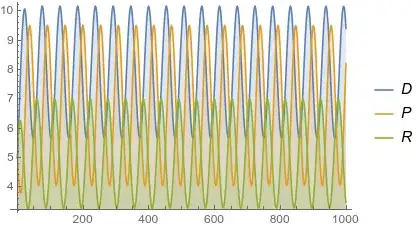
Mathematica graphics Mathematica graphics

This system slightly exceeds the maximum, $D$ rises to $10.1535\dots$, but avoids negative values.

We can generalize this to allow the $D'$, $P'$, and $R'$ values to be different and have values of $\alpha$, $\beta$, $\gamma$, and $\eta$ different from $1$. The resulting constraints on the memories for the three functions to produce a stable system are straightforward, but not easy to find. Adding non-negativity and maximality constraints make this less straightforward, but still not easy.

Eric Towers
  • 67,037
  • thankyou sir.being engineer I'm not very good in deep mathematics. can you please explain why the 4th row and column are added? I want to get some grip oven finding the eigenvalu thing and making system of equations more understanding because in real, the values for D', R' P' and alpha beta are not same. and if I change them the system goes in negative again so I want to make it in positive myself with your help and guidence. – Summyia Mar 25 '18 at 06:21
  • And what do you think sir, the system should diverge of converge? I am basically trying to develop a complex system with price demand and resources interaction. – Summyia Mar 25 '18 at 06:28
  • 1
    @Summyia : The fourth row and column are added in order to get the constant $1$ addends. The term of art is projectivization. ... Based on the examples so far, your system will converge, diverge, or be the sum of a short-lived transient and a periodic solution, with the difference depending on very fine tuning of these parameters. – Eric Towers Mar 25 '18 at 17:02
  • thankyou sir for explanation. One more thing sir, every time we change the values of parameters, we have to tune the system also? is this possible that the behaviour remains same( convergent or divergent) but changing values can only change its magnitude? and adding the row is based on some rule? because in row it is [0 0 0 1] while column is [1 0 1 1]?please can you explain? – Summyia Mar 25 '18 at 17:09
  • 1
    @Summyia : In "$D(t) = m_d D(t-1) + \left( 1 - \frac{P(t-1)}{P'} \cdot \alpha \right)$", how do we get the "$1$" if there isn't one in the matrix and the vector? The second equation has a $\dots -1 \dots +1 \dots$, so the fourth column has a zero in its second entry. – Eric Towers Mar 25 '18 at 17:18
  • thankyou sir.. Can we generalize these equations? like whatever change in values but behavior of system remains same. for example the predator prey model always converges – Summyia Mar 25 '18 at 17:23
  • 1
    Summyia : The predator-prey model very seldom converges to a steady solution -- most often asymptotically approaching cyclic solutions. And, the more you generalize, the more behaviours you can produce. – Eric Towers Mar 25 '18 at 17:27
  • sir how you find the value of x to be 0.95911? I tried with D' 100, R'=10, P'=20 and the eigenvalues with magnitudes are [1.0162 1.0162 0.9677 1.0000 ] and if I substitute 0.9677 in system, the result is again in negative – Summyia Mar 25 '18 at 17:48
  • 1
    @Summyia : If you change any of the parameters, you change the matrix and (very, very likely) change the eigenvalues, so you have changed the critical value of $x$. The eigenvalue criterion doesn't prevent negatives -- it prevents divergence (which, if oscillatory, guarantees negatives). If you absolutely must prevent negatives, then you must project your initial condition onto the eigenspaces and ensure that the projection onto any oscillating and magnifying eigenspace is zero. – Eric Towers Mar 25 '18 at 18:23
  • 1
    @Summiya : Your two eigenvalues with magnitudes $> 1$ are a complex conjugate pair, so produce a two dimensional subspace of solutions which exponentially diverge and oscillate. You are guaranteed exponential growth with any eigenvalues of magnitude greater than $1$. To prevent exponential growth for all initial conditions, you must adjust $x$ so that the largest magnitude eigenvalue(s) is/are $\leq 1$. – Eric Towers Mar 25 '18 at 18:26
  • yes the x value is adjusted? but how we adjust x value? is there any method you can name or explain? – Summyia Mar 25 '18 at 18:35
  • 1
    @Summyia: I have explained, three times now. Numerically maximize $x$ so that the largest eigenvalue magnitude is $\leq 1$. – Eric Towers Mar 25 '18 at 18:51
1

Let's start with a generic version of your system, including memory constants (modeled on a single-pole filter, although not equivalent to one) as shown in my other answer to make it possible to get non-divergent behaviour. \begin{align*} D(t) &= m_d D(t-1) + \left( 1 - \frac{P(t-1)}{P'} \cdot \alpha \right) \\ P(t) &= m_p P(t-1) - \left( 1 - \frac{D(t-1)}{D'} \cdot \beta \right) + \left( 1 - \frac{R(t-1)}{R'} \cdot \gamma \right) \\ R(t) &= m_r R(t-1) + \left( 1 - \frac{D(t-1)}{D'} \cdot \eta \right) \\ D(0) &= d_0 \\ P(0) &= p_0 \\ R(0) &= r_0 \end{align*}

We wish to impose conditions so that $0 \leq D \leq D'$, $0 \leq P \leq P'$, and $0 \leq R \leq R'$.

We can write this system as $$ \begin{pmatrix} D(t) \\ P(t) \\ R(t) \\ 1 \end{pmatrix} = \begin{pmatrix} m_d & \frac{-\alpha}{P'} & 0 & 1 \\ \frac{\beta}{D'} & m_p & \frac{-\gamma}{R'} & 0 \\ \frac{-\eta}{D'} & 0 & m_r & 1 \\ 0 & 0 & 0 & 1 \end{pmatrix} \cdot \begin{pmatrix} D(t-1) \\ P(t-1) \\ R(t-1) \\ 1 \end{pmatrix} $$

The eigenvalues of this matrix are $1$ and $\frac{1}{D'P'R'}$ times each of the three roots of $$ x^3 - D'P'R'(m_d + m_p + m_r) x^2 + (D'P'R')^2 \left(m_d m_p + m_d m_r + m_p m_r + \frac{\alpha \beta}{D' P' R'} \right) x - (m_r R')(D'P'R')^2 \left(m_d m_p D' P' + \alpha \beta - \frac{\alpha \gamma \eta}{m_r R'}\right) \text{.} $$ The discriminant of this cubic is $$ D'^3 P'^3 R'^4 ((D' (m_d - m_p)^2 P' - 4 \alpha \beta) (D' (m_d - m_r) (m_p - m_r) P' R' + R' \alpha \beta)^2 + 2 D' (m_d + m_p - 2 m_r) P' R' \alpha (D' (2 m_d - m_p - m_r) (m_d - 2 m_p + m_r) P' - 9 \alpha \beta) \gamma \eta - 27 D' P' \alpha^2 \gamma^2 \eta^2) \text{.} $$ If this is zero, the eigenvalues are real and two of them are equal. This is positive if the eigenvalues are distinct real numbers and is negative if there are one real and two complex conjugate eigenvalues. (These three outcomes are predicated on the fact that all the parameters of this system are real.)

For each eigenvalue,

  • If it is real and greater than $1$ the projection of the initial conditions (the vector $(d_0, p_0, r_0, 1)$) onto its corresponding eigenvector will exponentially diverge.
  • If it is real and equal to $1$, the projection of the initial conditions onto its corresponding eigenvector will be present in the solution forever.
  • If it is real and less than $1$, the projection of the initial conditions onto its corresponding eigenvector will exponentially decay.
  • If it is non-real, then the projection of the initial conditions onto its corresponding eigenvector will oscillate. And that projection exponentially diverges, maintains constant amplitude, or exponentially decays depending on whether the magnitude of the eigenvalue is greater than $1$, equal to $1$, or less than $1$, respectively.

The eigenvector corresponding to the eigenvalue $1$ is $$\left( \frac{-(D' ((m_p-1) (m_r-1) P' R' + \alpha \gamma)}{D' (m_d-1) (m_p-1) (m_p-1) P' R' + (m_r-1) R' \alpha \beta - \alpha \gamma \eta)}, \frac{P'e ((m_r-1) R' \beta - \gamma (D' (m_d-1) + \eta))}{(m_r-1) R' (D' (m_d-1) (m_p-1) P' + \alpha \beta) - \alpha \gamma \eta}, \frac{-(R' (\alpha \beta + (m_p-1) P' (D' (m_d-1) + \eta))}{(m_r-1) R' (D' (m_d-1) (m_p-1) P' + \alpha \beta) - \alpha \gamma \ \eta)}, 1 \right) \text{,} $$ so the projection of the initial vector $(d_0, p_0, r_0, 1)$ onto this vector is a constantly preserved component of the solution. ("The DC component" in some settings.)

Explicitly algebraically finding the other three eigenvalues and their eigenvectors is prohibitively expensive computationally, so one instead picks values of the parameters, finds the eigensystem, and then projects the initial conditions onto each of the eigenvectors. The resulting solution to the system is a sum of components, one from each eigenvalue, and one checks whether the solution ever becomes negative. As described, the maximum and minimum values of the solution depend linearly on the initial conditions, so you can find (linear) constraints on the initial conditions to ensure only properly bounded solutions are produced.

Eric Towers
  • 67,037
  • alright sir.appreciated..just a small confusion.. will (1-(D(t-1)/D'))* alpha is written same in matrix as (1-D(t-1)/D')*alpha? I mean in 1st row 2 element can be (1-alpha)/D'? – Summyia Mar 25 '18 at 18:57
  • 1
    @Summyia : They are not the same. You have already been asked about this. See the third comment to your Question. – Eric Towers Mar 25 '18 at 18:58
  • yes sir then why didnt we consider 1 in matrix? as alpha is multiplied by the whole term (1-(D(t-1)/D')). I mean to write like this.. (alpha - (alpha/D')) is this wrong? I'm trying to learn the matrix form of difference equation from other sources but this thing is confusing – Summyia Mar 25 '18 at 19:05
  • 1
    @Summyia : Your question has $\left( 1 - \frac{D(t-1)}{D'} \alpha \right)$. It does not have $\left( 1 - \frac{D(t-1)}{D'} \right) \alpha$, therefore, we do not multiply the entire term by $\alpha$. If you mean some system other than the one you placed in your Question, you should ask a new Question about the system you actually want to study. – Eric Towers Mar 25 '18 at 19:27
  • Tower: with the values of P′ , D′, R′, changed, I sorted out value of x where eigenvalues become <1. when I tried that value in system. the behavior was still negative. the values for P′ , D′, R′, were 20, 100, 10 and x was calculated to be 0.98379 when the eigenvalues were [0.99996 0.999960 0.9514482 1] in magnitude. – Summyia Mar 27 '18 at 01:25
  • the question is asked again at this link https://math.stackexchange.com/questions/2709609/error-in-finding-positive-solution-space-boundary-for-difference-equation – Summyia Mar 27 '18 at 01:37