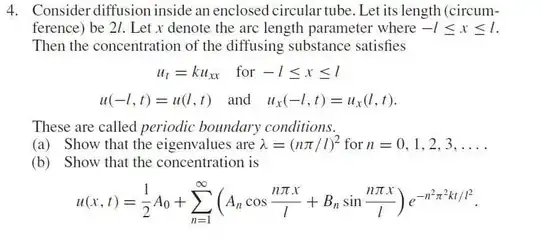
I proceeded with using separation of variables:
$$\frac{T'(t)}{kT(t)}=\frac{X''(x)}{X(x)}=-λ$$
Assuming $λ=β^2>0$, I end up with:
$$X''(x)+λX(x)=0$$ and its general solution:
$$X(x)=A_n\cos(\beta x)+B_n\sin(\beta x)$$
Now, the periodic boundary conditions come to play:
$$X(L)=X(-L)$$ $$A_n\cos(\beta L)+B_n\sin(\beta L)=A_n\cos(\beta L)-B_n\sin(\beta L)$$ $2B_n\sin(\beta L)=0$ so $\beta L=n\pi, n=1,2,\ldots$
$$λ=\left(\frac{n\pi}{L}\right)^2$$ which can be derived from the second condition as well.
My question has to do with (b):
Why do we have to separate $\dfrac{A_0}{2}$ from the rest of the infinite sum and what's the problem with $n$ being $0$?


